
World Nuclear Summit: 10 Key Announcements and Signals to Remember
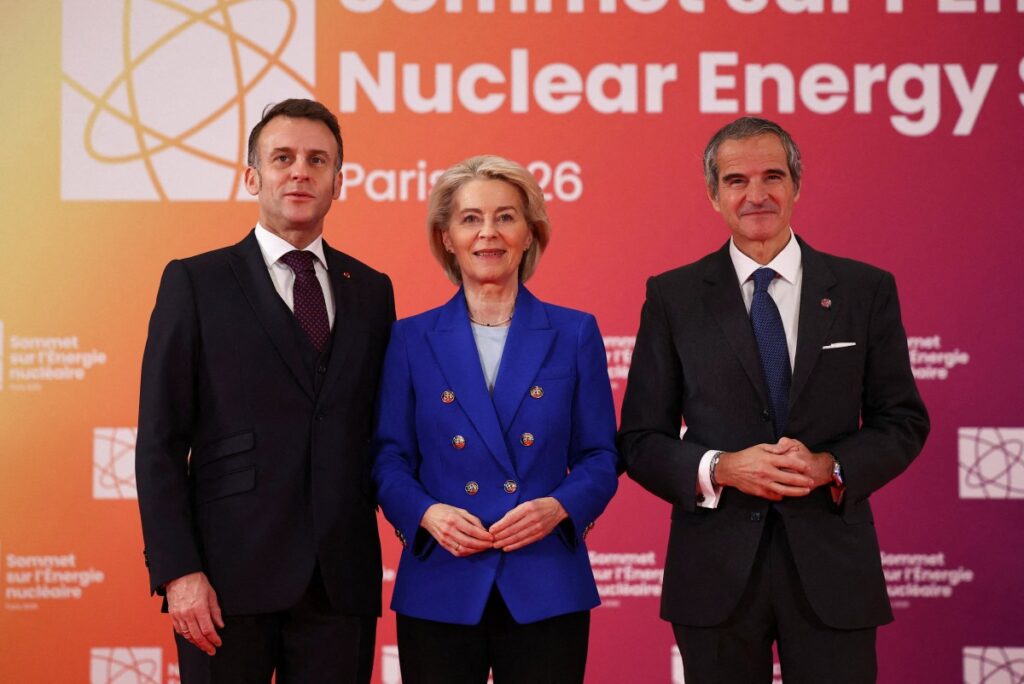
The second World Nuclear Energy Summit was held on March 10, 2026, in Paris, at La Seine Musicale in Boulogne-Billancourt. Organized by France together with the International Atomic Energy Agency (IAEA), it took place against a backdrop of rising energy prices and geopolitical tensions, highlighting the importance of a low-carbon energy mix. Here are the ten key takeaways selected by RGN.
1. 40 world leaders
Emmanuel Macron opened the summit by recalling the need for a “sustainable, secure and resilient energy system” in which nuclear power plays a central role. According to Le Monde, around 40 world leaders, including representatives from China, the European Union and others, gathered at La Seine Musicale to reaffirm their support for nuclear energy. This was an undeniable success at a time when, only a few years ago, nuclear power was still struggling to find its place in major international conferences.
Ensemble pour affirmer le rôle clé de l’énergie nucléaire civile pour notre indépendance énergétique, notre décarbonation et notre compétitivité. pic.twitter.com/sEimjDiAeu
— Emmanuel Macron (@EmmanuelMacron) March 10, 2026
The day before, on March 9, Rafael Grossi, Director General of the IAEA, spoke at a Sfen event dedicated to the R&D infrastructure needed to support the nuclear revival. He stated: “For a long time debated, criticized or misunderstood, nuclear energy is now undergoing a shift, and the scientific community bears a major responsibility.”
2. Financing at the heart of priorities
Like many other heads of state, Emmanuel Macron called for new financing mechanisms to support nuclear programmes. In his opening speech, the French president declared: “I call on all stakeholders, both public and private, to play their part in financing new projects.”
He insisted that “banks and insurers must go further in supporting nuclear”, stressing that it was time to “wake up” and mobilize both private and public capital in support of nuclear energy.
3. €200 million guarantee for SMRs in Europe
Ursula von der Leyen, President of the European Commission, used the summit to unveil a European strategy in support of small modular reactors (SMRs). She announced the creation of a €200 million guarantee, financed through the EU carbon market, to attract private investment into innovative nuclear technologies.
Although this measure was presented as a first step to “improve investment conditions” for nuclear energy, many nevertheless regretted the modest scale of the amount announced.
4. A “strategic mistake” in Europe’s nuclear decline
On the same occasion, Ursula von der Leyen described Europe’s retreat from nuclear power over recent decades as a “strategic mistake.” She recalled that nuclear’s share had fallen from around one-third of Europe’s electricity generation in 1990 to only 15% today, although in reality it is closer to 25%. In her view, this decline reflects a “lack of anticipation” in the face of climate challenges. This position illustrates the European Commission’s change in tone on nuclear energy, long contested by some Member States but now increasingly regarded as a key component of the continent’s energy sovereignty and industrial competitiveness.
5. Growing support from financial institutions
Several multilateral banks and financial institutions confirmed their repositioning in favour of nuclear energy. In 2025, the World Bank formally established a partnership with the IAEA to support nuclear power in developing countries, an initiative widely referenced from the summit stage. The European Bank for Reconstruction and Development (EBRD) and the European Investment Bank (EIB), which had long excluded nuclear from their financing activities except for decommissioning or waste management, are now becoming more involved in projects related to the long-term operation of existing reactors as well as the construction of new large reactors and SMRs.
6. EDF creates an advisory board on nuclear financing
To help projects clear the financial hurdle, EDF announced the creation of an advisory board dedicated to the financing of civil nuclear power. FINABe (Financing and Investing in Nuclear Advisory Board EDF) will bring together representatives from major financial institutions, including banks and public investment bodies such as Bpifrance and Caisse des Dépôts, in order to structure financing models for future reactors, including SMRs.
“As many countries consider launching new nuclear programmes, access to credible financing solutions is now just as decisive as the choice of technology itself,” explained Claude Laruelle, EDF Group Executive Director in charge of Performance, Impact, Investment and Finance, in a press release.
7. Calogena and Jimmy backed by France
From the summit stage, Emmanuel Macron confirmed state support for two French start-ups developing SMRs dedicated to heat production: Calogena, part of Groupe Gorgé, and Jimmy, through the France 2030 programme. Jimmy says it has secured €80 million in financing, including €40 million from France 2030, to develop its reactor designed for industrial heat. For its part, Calogena has referred to around €100 million in investment, including €48 million in public support.
8. A global coalition to triple nuclear capacity by 2050
The summit also highlighted the international coalition committed to tripling global nuclear capacity by 2050. According to the IAEA, 38 states have already endorsed this ambition, with the latest additions being China, Brazil, Italy and Belgium. For its part, Gifen brought together 25 international associations, including the World Nuclear Association, Nucleareurope, NIA UK and China’s CNEA, around a joint declaration calling for global nuclear capacity to be tripled by 2050 in order to achieve carbon neutrality. The declaration stresses that low-carbon, dispatchable nuclear energy is essential to reduce dependence on fossil fuels and guarantee global energy security.
9. Nuclear power in the service of AI and data centres
Emmanuel Macron also linked nuclear energy to digital challenges. He recalled that France exported 90 TWh of decarbonized electricity in 2025 thanks to its nuclear fleet. According to him, this makes it possible “to open data centres and to be at the heart of the artificial intelligence challenge, with dispatchable, decarbonized energy.” The idea is clear: to power energy-intensive computing centres for AI and big data, nuclear can provide abundant, stable and competitive electricity.
10. A scientific side event on R&D
On the eve of the summit, an official scientific side event was held on the research infrastructure needed to support the nuclear revival. The event was organized by the French Nuclear Energy Society (Sfen), the European Nuclear Society (ENS) and the CEA around the theme: “What R&D infrastructures to support the nuclear revival?”
Several contributions stood out during the discussions. Anne-Isabelle Étienvre, Chairwoman of the CEA, underlined that “research facilities sometimes remain in the shadows.” Yet, she reminded participants, they are the true “crown jewels”: research reactors, critical mock-ups, hot laboratories, non-nuclear testing facilities and simulation tools. Laurent Kueny (DGEC) referred to the past by citing “the Phénix reactor, a symbol of a France that dares, that is not afraid of technological challenges, and that has mastered technologies such as fast neutron reactors, which the world is now rediscovering.” Lastly, Rafael Grossi, Director General of the IAEA, inspired by this French initiative, announced that an international summit dedicated to nuclear R&D would be organized before the end of the year at IAEA headquarters in Vienna.
Momentum behind nuclear power also requires momentum in research and development. And this momentum is gaining pace.
Ahead of #NES2026 tomorrow, I joined an event organized by @SFENorg and @euronuclear with support from @CEA_Officiel in Paris on strengthening R&D infrastructure… pic.twitter.com/21GnRirG9p
— Rafael Mariano Grossi (@rafaelmgrossi) March 9, 2026
■
By Ludovic Dupin, Sfen
Image: French President Emmanuel Macron, European Commission President Ursula von der Leyen and Rafael Grossi, Director General of the International Atomic Energy Agency (IAEA), pose during the Nuclear Energy Summit on March 10, 2026. © ABDUL SABOOR / POOL / AFP