
Brussels approves Polish nuclear aid, but reshapes the economic model
By approving the public support scheme for Poland’s first nuclear power plant, Brussels has cleared the way for an acceleration of the country’s decarbonisation project. But beyond the approval of the Lubiatowo-Kopalino project, the decision outlines above all a new model of nuclear support in Europe, no longer based solely on electricity production, but on the contribution of nuclear power to the electricity system.
In 2025, coal and lignite still account for 43.7% of Poland’s electricity generation[1]. To reduce this dependence on fossil fuels, Warsaw confirmed the launch of its civil nuclear programme in November 2022. The U.S. company Westinghouse was selected to build the country’s first nuclear power plant, at the Lubiatowo-Kopalino site in north-western Poland. The project plans for the installation of three AP1000 reactors. In the longer term, the Polish government aims to deploy between 6 and 9 GW of nuclear capacity by 2043.
In September 2024, the Polish authorities notified the European Commission of a support scheme for the nuclear programme in the form of State aid. The total investment cost is estimated at around PLN 192 billion (approximately €46 billion), for a net installed capacity of 3.3 GW. Poland will finance its first nuclear power plant through a structure combining 30% equity provided by the State and 70% debt guaranteed 100% by the State.
This debt financing is expected to come mainly from U.S. and international export credit agencies, as well as from financial markets. Revue Générale Nucléaire (RGN) previously analysed this financing model. On 18 December 2024, the European Commission formally opened its review procedure and published the key elements of the financing scheme.
Brussels approves the aid, but imposes safeguards
In early December 2025[2], the European Commission approved the Polish State aid scheme. The public support planned for Poland’s first nuclear power plant was found to be compatible with European Union State aid rules. The Commission assessed the aid under EU law and concluded that it complies with the applicable rules allowing Member States to support the development of certain economic activities. The Commission seeks to ensure that such aid remains necessary and proportionate, without distorting competition.
To obtain approval for its State aid scheme, Poland had to accept several concessions.
- Reduction of the Contract for Difference (CfD) from 60 years to 40 years.
- Modification of the CfD design: this change aims to provide “a strong incentive for PEJ to operate the plant efficiently and to use its capacity to respond to market signals.” The plant will no longer be remunerated on the basis of the volume of electricity produced, but rather for its availability to generate electricity when the system needs it. One of the objectives is to protect renewable energies. This approach makes the electricity system “more efficient and decarbonised,” the European Commission emphasised.
- Adjustment of the strike price based on the project’s financing needs. Poland will determine it using a financial model that takes into account the equity contribution and State guarantees. The goal is to ensure that public support does not exceed what is strictly necessary to deliver the project. This model also guarantees that PEJ (Polskie Elektrownie Jądrowe) will obtain a return comparable to that expected by private investors for a similar project.
- To mitigate risks linked to market concentration and to prevent the aid from being passed on to consumers, Poland accepted strict conditions on electricity sales. At least 70% of the plant’s annual electricity output will be sold on the European electricity market throughout the lifetime of the installation. The remaining production may be sold via auctions conducted under objective, transparent and non-discriminatory conditions.
Alongside this approval, Poland launched preparatory works for the project in early September 2025[3]. In late December 2025, PEJ signed an agreement with the Westinghouse-Bechtel consortium to carry out the design work for the nuclear island and the turbine island, as well as extensive geological campaigns[4]. This ensures continuity of the project schedule by advancing plant design and on-site works.
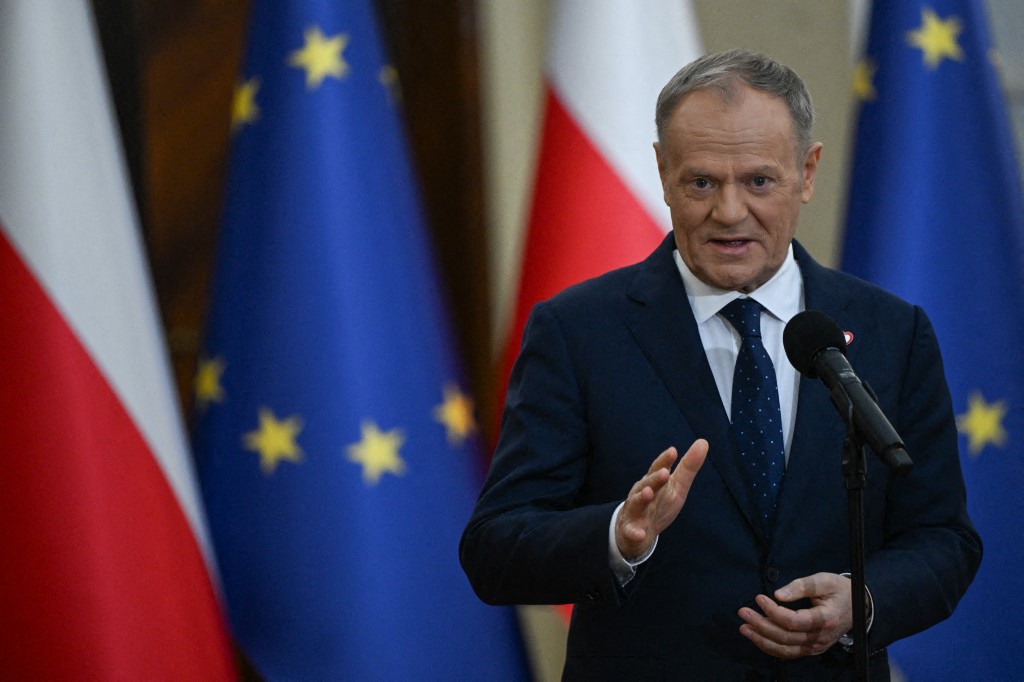
“We will indeed be in a position to launch construction with sufficient momentum so that electricity from Poland’s first nuclear power plant can flow as quickly as possible,” said Donald Tusk, Prime Minister of Poland, expressing Poland’s ambition to keep the project on schedule.
A European precedent for nuclear State aid
At the end of December, the European Commission opened an in-depth State aid investigation into the construction of two nuclear reactors at the Dukovany site in the Czech Republic[5]. Meanwhile, France, with EDF, is preparing to announce by the end of 2026 the final investment decision for the construction of six EPR2 reactors. In this context, the European Commission’s approval of the Polish aid scheme constitutes a significant precedent and could serve as a reference framework for the assessment of future public support mechanisms for nuclear energy. ■
By Floriane Jacq (Sfen)
Image: Donald Tusk, Prime Minister of Poland – © Artur Widak / NurPhoto / NurPhoto via AFP
References
[1] Pologne : pour la première fois, la production d’énergie renouvelable dépasse celle du charbon | Euronews
[2] Commission approves Polish State aid
[3] Pologne : lancement des travaux de sa première centrale nucléaire et choix du site pour son premier SMR – Sfen
[4] Polskie Elektrownie Jądrowe and Westinghouse-Bechtel Consortium conclude amendment to EDA – Polskie Elektrownie Jądrowe
[5] La Commission européenne enquête sur le financement de Dukovany – Sfen