
Reactor operation beyond 60 years: a heavy agenda for France’s nuclear safety authority
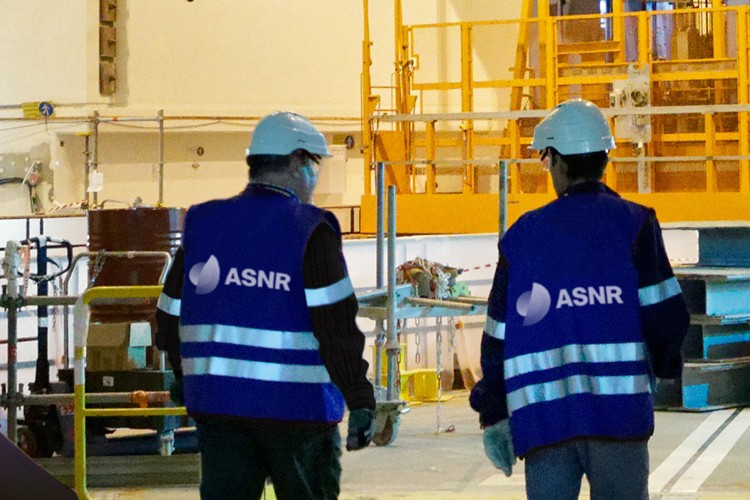
Beyond the development of the six EPR2 reactors or fuel cycle programmes, extending the operating lifetime of existing nuclear facilities will be one of the main areas of focus for the Autorité de sûreté nucléaire et de radioprotection (ASNR) in 2026. The nuclear regulator is expected to publish a position in November on the possible limits of reactor operation beyond 60 years.
Barely one year after its creation, the ASNR already faces a packed agenda. The authority was established through the merger of the former Autorité de sûreté nucléaire (ASN) and the Institut de radioprotection et de sûreté nucléaire(IRSN). Against the backdrop of France’s nuclear revival, regulatory dossiers are accumulating. During his New Year address on Tuesday 27 January, ASNR President Pierre-Marie Abadie highlighted reactor lifetime extension as a key issue, alongside EPR2 development, fuel cycle programmes and stress corrosion cracking. In ASNR terminology, the DDF (durée de fonctionnement – operating lifetime) will be the subject of a dedicated publication in November 2026.
“We are currently in a generic phase of identifying the barriers that could compromise the extension of nuclear plant operation beyond 50 and 60 years,” ASNR representatives explained. The durability of certain critical components is a central concern. ASNR’s work focuses primarily on non-replaceable components, including the containment building, the reactor pressure vessel, certain elements of the primary circuit, as well as concrete structures, all of which receive particular scrutiny.
Replaceable components
Other reactor components are also being examined.
“Some components are difficult to replace,” explains Jean-Luc Lachaume, ASNR Commissioner. “For instance, while replacing a faulty cable in a power plant is relatively easy, replacing all of the cabling is extremely complex.”
The opinion on ageing management that ASNR will publish in November 2026 will not, on its own, constitute a decision on whether or not reactors may operate beyond current limits.
“We will identify the ‘no-go’ points, but this report should not be interpreted as an approval for EDF or as a green light,” stresses Pierre-Marie Abadie. ASNR’s role is limited to identifying potential blocking issues and possible countermeasures.
One step at a time
In some cases, technical solutions may be implemented.
“When EDF carries out inspections of reactor pressure vessels, existing tools may not detect the smallest flaws. In such cases, ASNR applies a precautionary approach and assumes that such flaws may exist. The operator can then develop more advanced inspection tools to resolve these uncertainties,” ASNR experts explain.
ASNR also notes that international experience in long-term operation (LTO), particularly in the United States, cannot be directly transposed to the French nuclear fleet.
“The energy environments of the two countries are very different, which means results cannot be inferred solely from foreign data,” Pierre-Marie Abadie points out. The same applies to plant lay-up or mothballing strategies. While ASNR avoids speculation on this topic, it recalls that “stop-and-go approaches are detrimental to safety, particularly with regard to operational skills and reactor restart capabilities.”
Load-following under scrutiny
On the issue of nuclear load-following, a topic of growing importance for the French nuclear sector, Pierre-Marie Abadie is clear:
“The issue must be addressed objectively, so that discussions are based on robust technical evidence.”
ASNR is actively examining the matter.
“If there are impacts, they are located in the secondary circuit, not in the primary circuit or the reactor core. These systems were designed to handle production variations, with built-in capacity control capabilities,” the regulator explains. The components potentially affected by load-following are, in principle, replaceable. ASNR also notes that the recent increase in the frequency of load-following operations is already having observable effects. “These new operating conditions may disrupt, or at least modify, control room operators’ activities. This is therefore a point of attention from an organisational and human factors perspective.”
“Safety must be proportional to the stakes,” concludes Pierre-Marie Abadie. “We need proper prioritisation, so that regulators, operators and the entire value chain focus on the right issues at the right time.”
In this context, reactor lifetime extension is a critical challenge. Since France’s reactors were built over a relatively short time span, their shutdown could also occur within a limited timeframe, creating a steep investment cliff.
“We must avoid a situation where we would be forced to arbitrate between security of supply and nuclear safety,” warns the President of ASNR. ■