
[Nuclear by the Numbers] Nearly 500,000 Direct and Indirect Jobs in the EU

With the “Nuclear in Numbers” series, the Revue Générale Nucléaire (RGN) sheds light on energy issues through key data. Today, we take a closer look at the economic impact of nuclear energy, based on a study by the consulting firm Deloitte, published by NuclearEurope on June 5.
The global nuclear revival is driven by energy and climate challenges. But beyond these critical issues, nuclear energy also provides significant economic and social benefits. This was clearly demonstrated in Deloitte’s recent study. The method used is known as input-output analysis, which allows for an examination of how various sectors of an economy are interconnected. This approach highlights the way investments in nuclear energy circulate through and stimulate the broader economy. The study assesses direct, indirect, and induced impacts. Here, we focus specifically on employment.
Nuclear Energy: A Strong Driver of Employment
In 2023, the nuclear industry supported 134,800 direct jobs, covering construction, operation, and decommissioning activities.
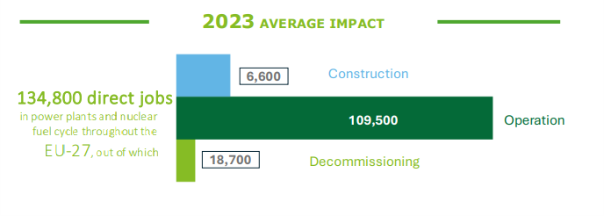
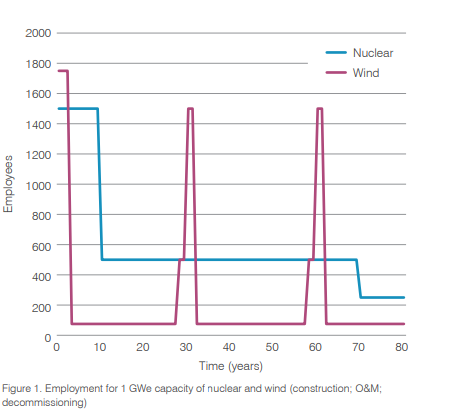
A nuclear reactor, even after the construction phase, requires a wide array of services, materials, and equipment. This involves a large number of companies and, therefore, jobs. In 2023, the nuclear sector supported 363,000 indirect jobs. By contrast, other energy sectors, such as wind power, tend to concentrate jobs during the construction phase, with far fewer positions needed for operations and maintenance.
Looking ahead to the 2025–2050 period, under a scenario targeting 200 GW of installed nuclear capacity, the sector is projected to support 316,000 direct jobs and 638,000 indirect jobs.
A Greater Economic and Social Impact
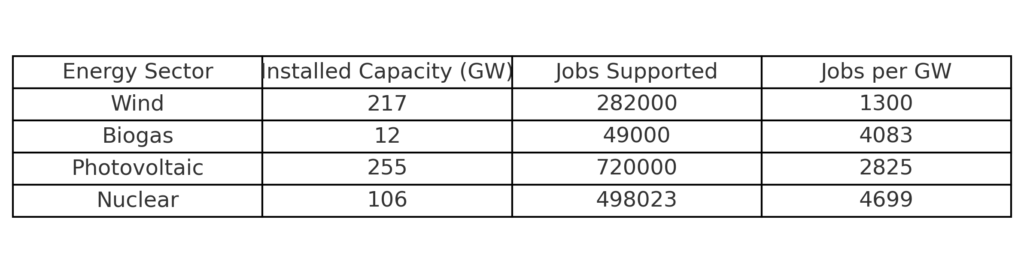
According to IRENA (International Renewable Energy Agency)[1], nuclear energy creates more jobs per installed gigawatt than any other energy source.
Moreover, Deloitte reports that nuclear energy accounted for 0.40% of the EU’s GDP in 2023, representing a total of €68.5 billion. In comparison, wind energy contributed 0.29%, and solar energy just 0.03%. While nuclear projects require high initial investment, they are quickly offset by the social and economic benefits, according to Deloitte’s analysis. The scale of nuclear investment should also be weighed against other public and private expenditures, as explored in exclusive work by Sfen. ■
By Floriane Jacq (Sfen)
[1] International Renewable Energy Agency – “Renewable Energy and Jobs” Study, 2024