
[#IYNC 2026 Series] New Generation, New Momentum: Japan’s Nuclear Sector Undergoing Renewal
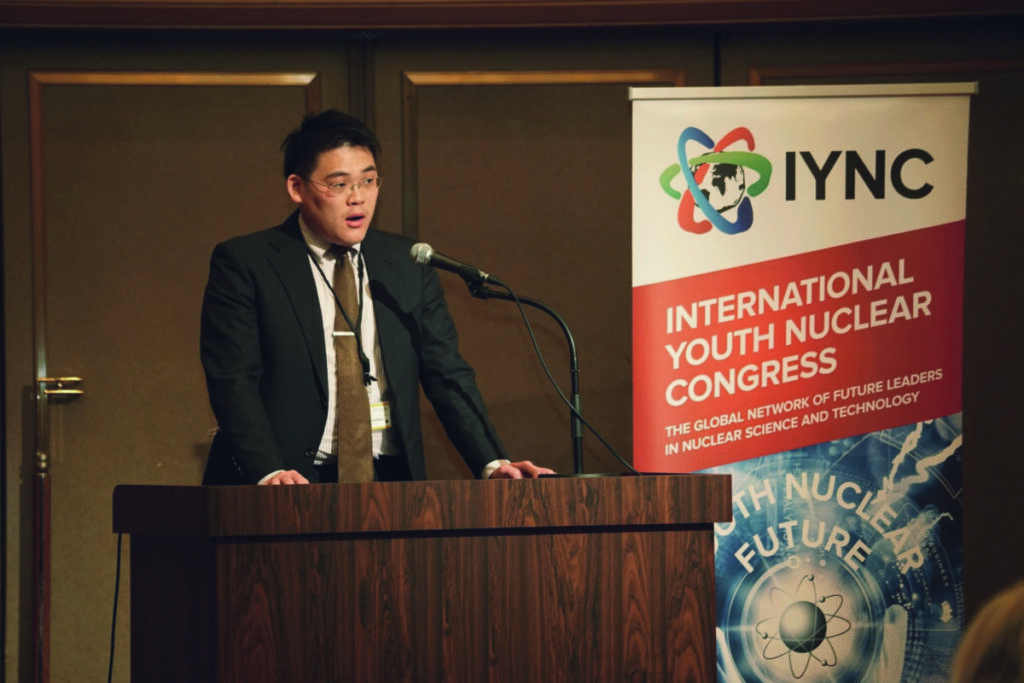
The biennial International Youth Nuclear Congress (IYNC) will take place from 5 to 9 October 2026 in Avignon, France, under the presidency of Benoît Erbacher. As this event, organised in France for the first time, approaches, the Revue Générale Nucléaire (RGN) offers a global overview of how young professionals view the nuclear sector. Today, the spotlight turns to Japan’s new generation of nuclear professionals.
Fifteen years after the Fukushima accident, a new generation of Japanese engineers is stepping forward to reshape the nuclear sector. The industry is restructuring, strengthening its safety culture and opening up to innovation, marking a turning point for the country’s energy future. Professionals such as Kota Kawai and Kyohei Yoshingana, who organised the 2022 edition of the International Youth Nuclear Congress, demonstrate that the next generation is ready to act.
Although nuclear energy represented only 9.5 percent of Japan’s electricity mix in 2024, the country is once again relying on nuclear power, notably through next-generation reactors, to enhance its energy independence and contribute to CO₂ emission reductions. Initial signs of this revival are encouraging. On 21 November, local authorities approved the restart of Units 6 and 7 of the Kashiwazaki-Kariwa Nuclear Power Plant, the largest nuclear power plant in the world*.
Fukushima in Mind, the Future in Hand
Despite a public opinion still deeply marked by Fukushima, with 55 percent of Japanese respondents associating nuclear energy with “danger”, a new generation of engineers is asserting itself to build a safe and sustainable energy future. “Even if this cognitive dissonance is ever-present, we choose to commit ourselves to long-term and responsible careers,” explain Kota Kawai, a specialist in radioactive waste management, decommissioning and the nuclear fuel cycle, and Kyohei Yoshingana, a researcher in electrical and energy technologies at Mitsubishi Electric.
By placing safety and technical excellence at the core of their commitment, nuclear energy becomes a credible option in the face of climate change. “A questioning attitude is required at every stage,” warns Kyohei Yoshingana, while recalling that “absolute safety does not exist.” For his part, Kota Kawai stresses that maintaining high standards remains a cornerstone of nuclear credibility. Japan’s nuclear framework has been thoroughly reformed. The June 2025 energy law replaces the concept of an operating lifetime with that of an operation period, making it possible not to count the decade of shutdown following Fukushima toward the total authorised operating duration.
“The next generation is not merely adapting to change; it is redefining it,” the two engineers emphasise.
IYNC: International Knowledge Sharing
“In 2022, we gathered more than 350 young professionals under the age of 40 in Kōriyama, Fukushima Prefecture, for the IYNC congress,” recalls Kota Kawai. IYNC’s primary mission is to facilitate the international transfer of knowledge and expertise between generations. In Japan, young professionals generally operate in a climate of strong social scrutiny and public sensitivity. The energy and enthusiasm of international participants at IYNC 2022 proved to be a genuine source of inspiration.
Observing young women engaging so actively, still a relatively rare phenomenon in Japan, also highlighted the potential for diversity and renewal within the sector.
A 2022 IYNC Finalist’s Perspective on Japan’s Young Generation
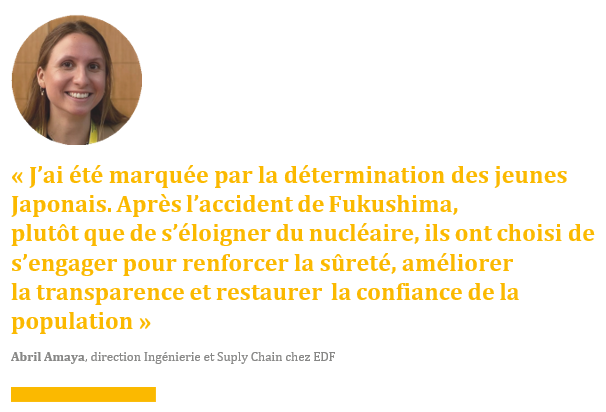
“Participating in these meetings had a real impact on my professional path,” says Abril Amaya, Process Engineer within Engineering and Supply Chain at EDF. Winner of the Innovatome competition organised by Sfen Young Generation, she competed in the global final held during IYNC 2022, which she won with her team Navigatom.
“The message is clear: we must learn from accidents to ensure they are never repeated, placing safety and safety culture at the heart of our actions. This approach is inspiring and demonstrates that young professionals play a key role in maintaining the attractiveness of the sector and contributing to a low-carbon future.”
The event provided a concrete understanding of safety challenges, particularly through the visit to Fukushima. These exchanges created a unique environment to observe practices, share experience and innovation, and demonstrate that the younger generation is central to the revival of nuclear energy in Japan and worldwide, combining technical expertise with active on-the-ground engagement.
Networks of Young Generations
Since the 1990s, young French professionals have contributed to the creation and development of IYNC. France, through Sfen Young Generation, remains strongly involved, with hundreds of volunteers participating in network activities. IYNC represents the voice of young professionals within international institutions, promotes intergenerational knowledge transfer through several programmes, and organises its biennial congress. Former President of Sfen Young Generation, Benoît Erbacher has served as President of IYNC since 1 October 2024. ■
By Benoît Erbacher, President of IYNC 2026, and Valentin Cottel, Public Affairs, Sfen Young Generation
Photo | Kota Kawai, specialist in radioactive waste management, decommissioning and the nuclear fuel cycle.