
French nuclear sector: key milestones ahead in 2026
2026 is shaping up to be a pivotal year for the French nuclear sector. Between the end of the ARENH mechanism and the introduction of the VNU, the expected decision on the EPR2 reactor programme and the Nuclear Energy Summit, several major milestones are now confirmed. However, some key policy files — such as the Multiannual Energy Programme and the so-called “Gremillet” bill — remain unresolved, amid political delays and parliamentary scheduling constraints.
End of ARENH and introduction of the VNU
From 1 January 2026, the end of ARENH (Accès régulé à l’électricité nucléaire historique – Regulated Access to Historic Nuclear Electricity) will mark the termination of a central mechanism governing electricity output from France’s existing nuclear fleet. This controversial scheme, introduced in 2011, will give way to a new system: the VNU (Versement Nucléaire Universel). The VNU will be based on a price-threshold mechanism linked to electricity sales prices, enabling the French State to levy part of the revenues generated and redistribute them.
Final Investment Decision (FID) for the EPR2 programme
One of the key milestones ahead is the Final Investment Decision (FID) for the programme of six new EPR2 reactors. The preliminary cost estimate, validated by EDF’s Board of Directors and published at the end of 2025, will be audited in the first quarter of 2026 by the Interministerial Delegation for New Nuclear (la Délégation interministérielle au nouveau nucléaire – DINN), a government body overseeing new nuclear projects. Following this phase, the Final Investment Decision is expected by the end of 2026.
Nuclear Energy Summit 2026
France will host the second Nuclear Energy Summit on 10 March 2026, co-chaired by French President Emmanuel Macron and Rafael Grossi, Director General of the International Atomic Energy Agency (IAEA). During the 69th IAEA General Conference, Anne-Isabelle Étienvre, High Commissioner of the French Alternative Energies and Atomic Energy Commission (CEA), stated that “France intends to make this summit a unique opportunity to affirm the recognition of nuclear energy, both as a means of combating climate change and as a guarantor of security of energy supply.”
Second phase of the France 2030 call for projects
As part of the France 2030 investment plan, a first call for projects focused on the emergence of French small reactor concepts, as well as the assessment of their scientific, technological and industrial credibility. A second phase is expected in 2026, with the objective of consolidating proof of concept, notably through more advanced work on nuclear safety documentation.
An awaited work programme for fast neutron reactors
A Nuclear Policy Council, expected in the first half of 2026, will examine the proposed work programme and industrial organisation put forward by stakeholders involved in fast neutron reactors and fuel reprocessing. These issues are central to closing the nuclear fuel cycle and ensuring the long-term and sustainable management of nuclear materials.
Parliamentary mission on electrification
The French Ministry of the Economy, led by Roland Lescure, has entrusted Raphaël Schellenberger, Member of Parliament for the Haut-Rhin constituency, with a six-month parliamentary mission starting in January 2026, focused on identifying and removing barriers to industrial electrification. The mission will proceed in two stages: first, an in-depth assessment of existing obstacles, followed by the formulation of legislative or regulatory proposals aimed at accelerating the electrification of France’s industrial base.
Young nuclear professionals gather in Avignon
Following a 2024 edition held in the United Arab Emirates, the International Youth Nuclear Congress (IYNC) will take place in Avignon from 4 to 9 October 2026, under the chairmanship of Benoît Erbacher, former president of SFEN Young Generation, the youth branch of the French Nuclear Society.
And still uncertain timelines…
Several important decisions remain pending, prolonging uncertainty for the sector:
-
Multiannual Energy Programme (PPE) still pending
France’s PPE (Programmation pluriannuelle de l’énergie – Multiannual Energy Programme) has still not been published. Although its release had been announced by the Prime Minister before Christmas, the decree has been postponed due to the political context. The most recent PPE currently in force, dated 21 April 2020 (PPE-2), is widely considered obsolete given the new outlook for the nuclear sector and the projects now underway. It notably provides for the shutdown of 12 nuclear reactors between 2025 and 2035.
-
The “Gremillet” bill: an unfinished parliamentary process
The parliamentary process is also incomplete for the private member’s bill known as the “Gremillet” bill, introduced by Senator Daniel Gremillet. The bill aims to provide France with a framework energy programming law. Although adopted at first reading by the Senate, it has not yet been scheduled for a second reading in the National Assembly, prolonging legal and political uncertainty. ■
By Thomas Jaquemet (Sfen)
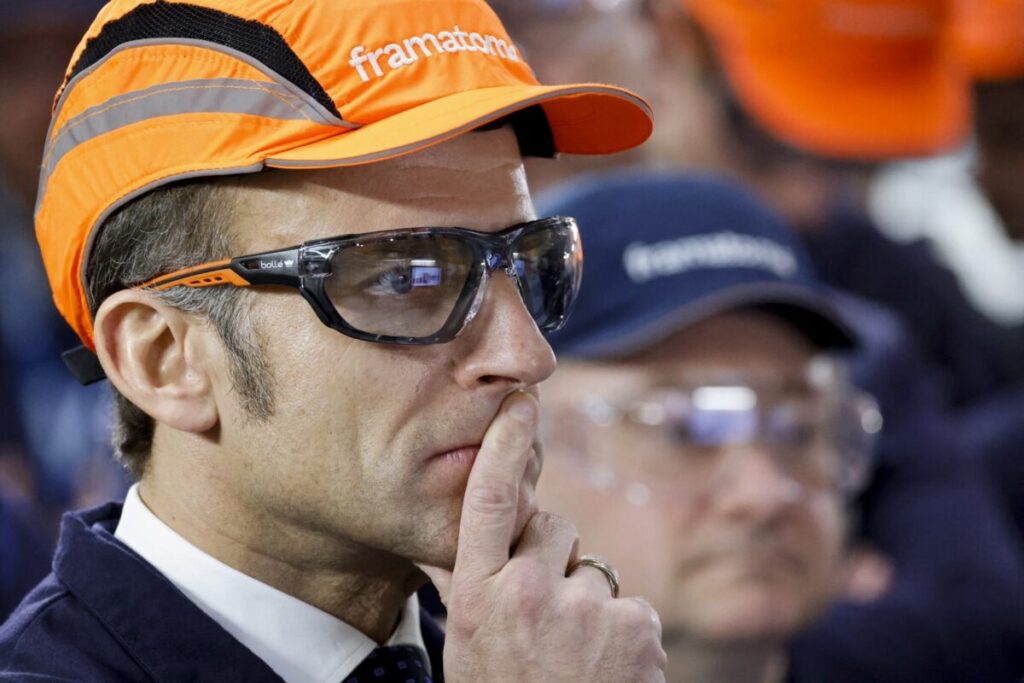
Image: Emmanuel Macron visiting a Framatome site in January 2025 © Ludovic Marin / Pool / AFP