
France reaches a record electricity mix: 95.2% low-carbon in 2025
In 2025, France produced 521.1 TWh of low-carbon electricity, setting a new historical record. With 95.2% low-emission electricity and exports that avoided 27 MtCO₂e in neighbouring countries, the French power system ranks among the least carbon-intensive in the world. RTE notes that the future challenge lies in the large-scale substitution of fossil fuel uses with electricity.
France has never had such a decarbonised electricity mix. With 521.1 TWh of low-carbon electricity generation, it stands as one of the least CO₂-intensive power systems worldwide. These are the key findings of the 2025 Electricity Report published last February by the transmission system operator RTE. “Emissions linked to electricity generation in France continued to decline, reaching the historic level of 10.9 MtCO₂e.” This is the lowest level in three years and a record since 1945. Today, the French electricity mix ranks among the most decarbonised in the world, with 95.2% low-emission electricity.
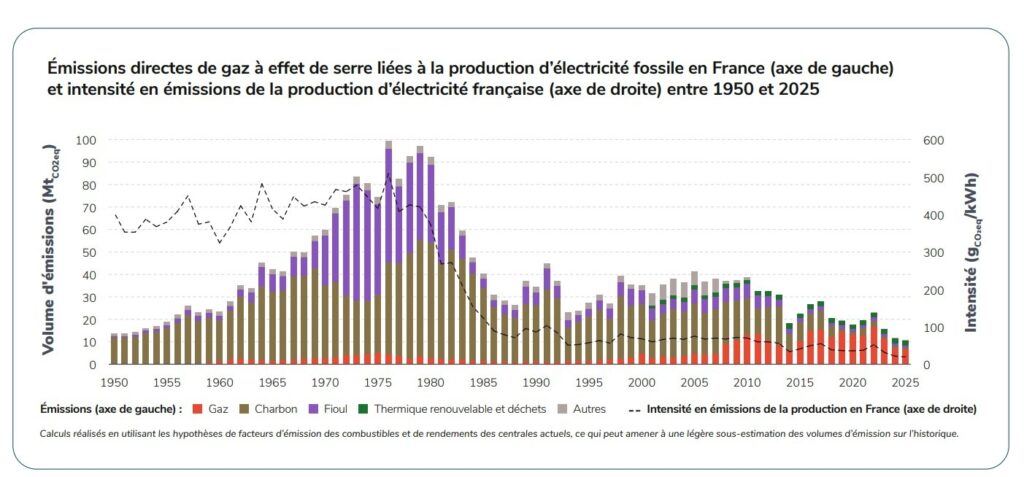
The benefits of French electricity also extend to neighbouring power systems. Thanks to French electricity exports, 27 MtCO₂e of emissions were avoided, mainly in Italy, but also in Germany and Belgium.
Electricity generation remains abundant
This record was made possible by a very high level of low-carbon electricity generation in 2025, “a historical maximum,” RTE notes. This performance was not guaranteed, as hydropower generation fell by 12.9 TWh last year compared with 2024.
Nuclear generation compensated for this decline, increasing by 11.3 TWh to reach 373 TWh, “thanks to improved availability of the nuclear fleet,” RTE explains. Solar and wind power also contributed, increasing by 8.1 TWh and 2.8 TWh respectively.
Overall, “electricity generation in mainland France reached 547.5 TWh in 2025,” the report states. This represents a slight increase of 8.2 TWh, or +1.5%, compared with 2024.
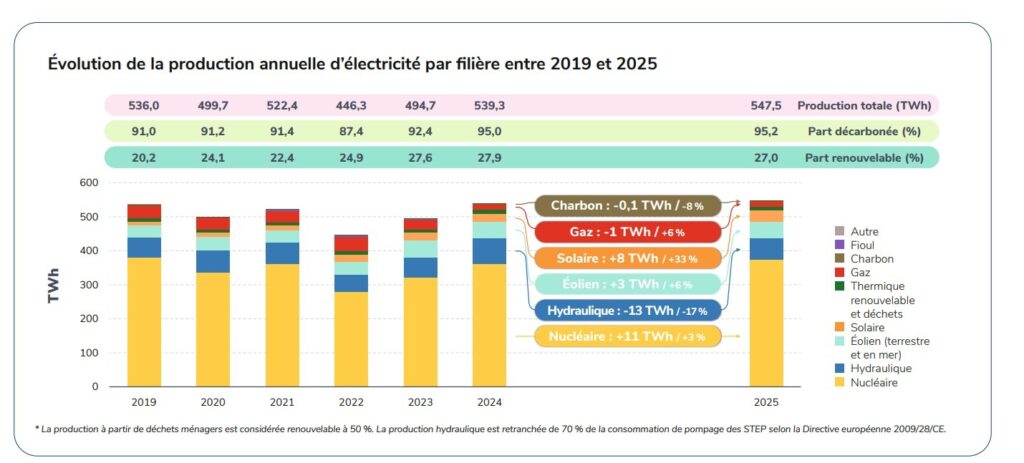
To meet decarbonisation targets, the challenge is no longer electricity production itself but, as RTE emphasises, “organising the large-scale substitution of fossil fuels with electricity.” Even though France no longer relies significantly on fossil fuels for electricity generation – their share declined again in 2025 (-1.3 TWh compared with 2024) – fossil fuels still account for nearly 60% of total energy consumption in the country.
Electricity consumption remains stable
Electricity consumption remained broadly stable in 2025 at 451 TWh, representing a slight increase of 0.4% compared with 2024. After the sharp decline recorded during the 2022 energy crisis, the fall in demand stopped in 2024. However, consumption remains 6% below the average level observed during the 2014–2019 period.
Unlike previous crises – the financial crisis of 2008–2009 or the health crisis of 2020 – no significant rebound in demand has been observed. As a result, the electrification of end uses “appears to be lagging behind the trajectories required to meet France’s climate targets,” RTE warns.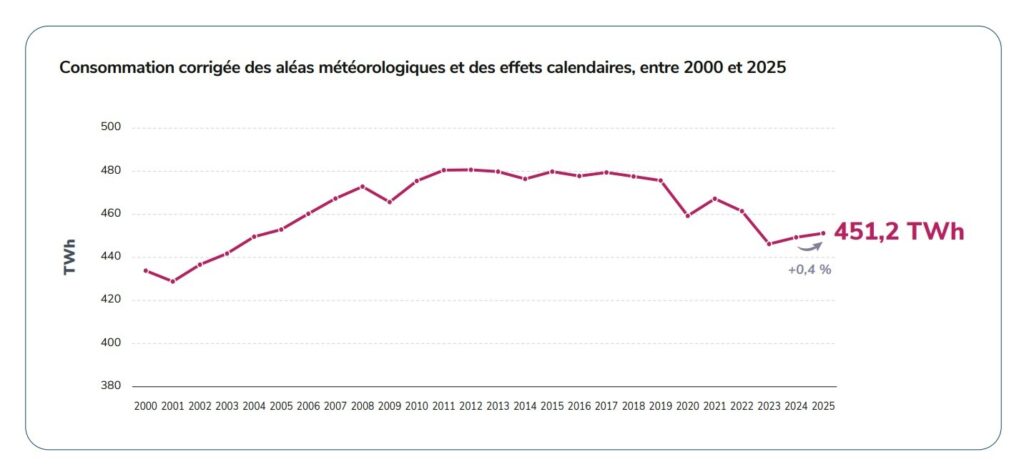 ■
■
By Floriane Jacq (Sfen)
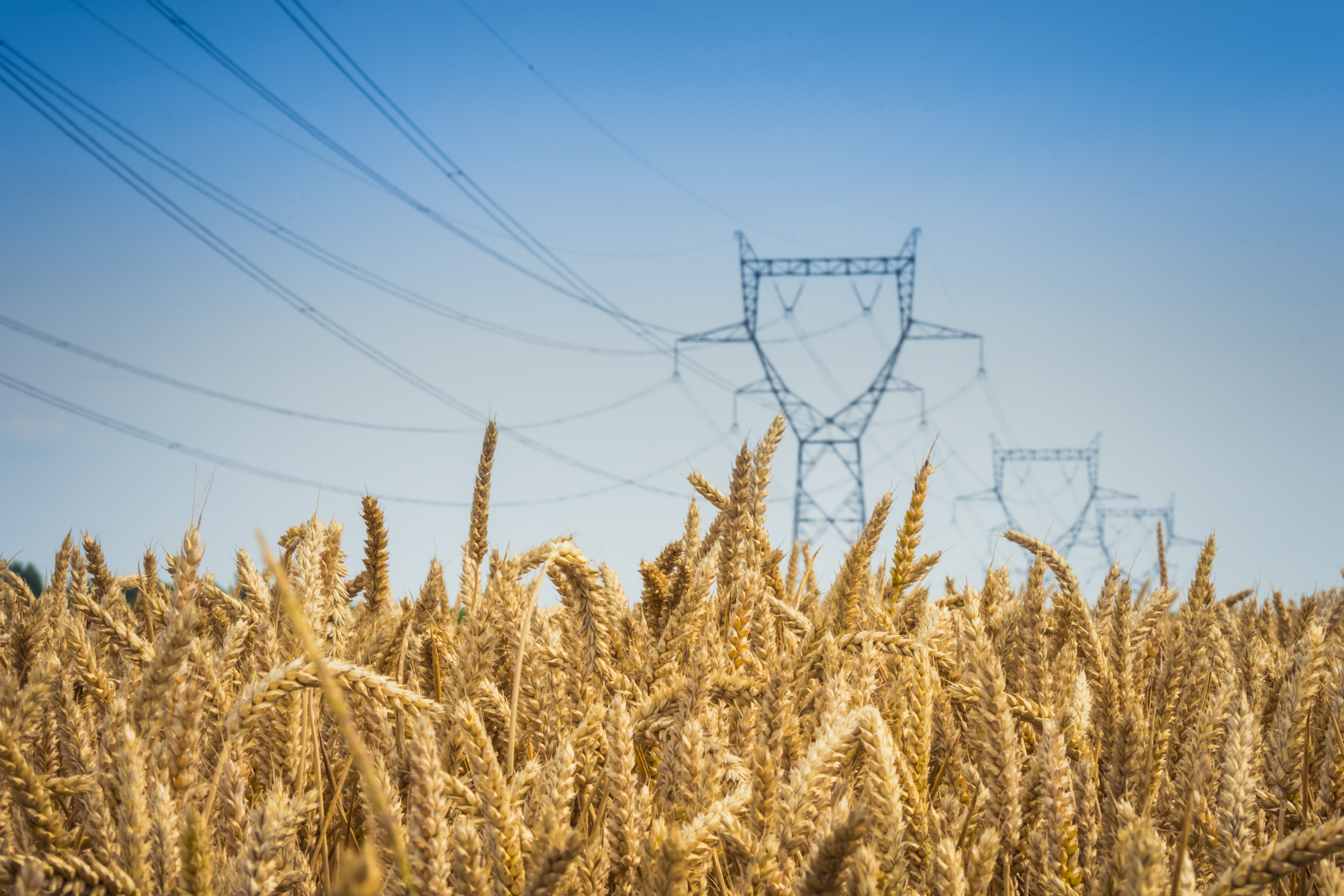
Image: Electricity transmission pylons in a wheat field © Damien Verrier