
Flamanville 3 at 80% Power, Full Steam Ahead Toward Industrial Commissioning
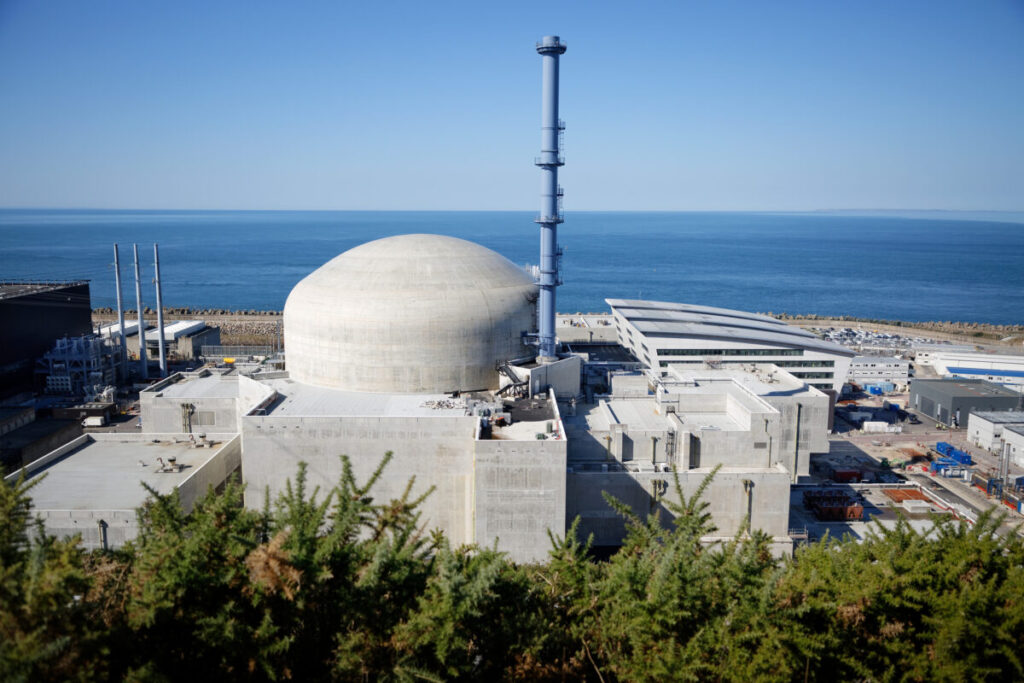
As Flamanville 3 reaches 80% of its nominal capacity, EDF is already looking beyond the full-power milestone expected before the end of autumn. The Group has in fact set the start date for the unit’s comprehensive inspection for 26 September 2026. This 350-day outage is the final major regulatory step before the EPR enters routine operation.
“It is an important day for Flamanville 3, for its employees and industrial partners, since early this afternoon the EPR reached 80% power, or about 1,200 MW,” said Sébastien Miossec, EDF Deputy Director for Production, during a press conference on Wednesday, 12 November. Still, there is little time for celebration: EDF still has work to do. The Group is preparing the unit’s comprehensive inspection – a 350-day outage beginning on 26 September 2026 that will ultimately allow the unit to operate like any other reactor in the French fleet.
A major milestone
All tests required to exceed 60% of the reactor’s nominal capacity were successful. “They allowed us to validate all components required for this threshold and to authorise the rise to 80% power,” explained Sébastien Miossec. This new step allows EDF to launch a new series of tests which will eventually lead to a request for authorisation from the Nuclear Safety and Radiation Protection Authority (ASNR). The approval of the nuclear watchdog is mandatory for Flamanville 3 to reach full power.
“We confirm that we are still targeting 100% capacity before the end of autumn 2025,” Miossec continued – no later than 21 December, exactly one year after the unit’s first grid connection. Reaching full power will trigger another round of tests leading to the industrial commissioning of the installation “during the first quarter of 2026.”
Although Flamanville 3 is not yet officially in commercial service, the electricity produced since its connection to the French grid is already being sold. “The EPR’s production is included in EDF’s commercial approach and taken into account in the company’s production trajectories for 2025 to 2027,” Miossec noted.
A one-year outage
“Once the tests at 100% power are completed, the reactor will enter full operation and will deliver its maximum output until it is shut down,” said Miossec. Like all reactors in the French fleet, Flamanville 3 must undergo a comprehensive inspection, beginning on 26 September 2026. This testing and maintenance phase must occur no later than 30 months after the first fuel load. “This step is roughly equivalent to a ten-year inspection combined with a full check-up of the installation,” says the EDF production executive.
Among the major activities planned are pressure tests at 205 bars on the primary circuit, which normally operates at 155 bars. Similarly, the containment building will undergo a pressure test to verify its tightness. The reactor vessel will also be examined and inspected. Additionally, the unit will receive upgrades, including replacement of the vessel head and improvements to the instrumentation and control system.
Around 20,000 work orders will be carried out during this phase, requiring the mobilisation of 2,500 staff on site at peak activity and involving 200 industrial partners. “These modifications incorporate a number of regulatory evolutions,” which explains the duration of the outage.
While the latest comprehensive inspection in France – at Civaux 1 – lasted 290 days, the Flamanville 3 inspection will require 60 additional days, assuming the schedule is met. “Beyond more prescriptive regulatory requirements than 20 years ago, the extended duration is also explained by the novelty of the EPR and its associated equipment,” Miossec noted.
This year-long test campaign will mark the final major step before the unit enters commercial operation, 20 years after the decree authorising its construction.■