
[Nuclear by the numbers] Nuclear is the EU’s largest source of electricity (23.5%)

With its series “Nuclear by the numbers”, the Revue Générale Nucléaire analyses major trends in the sector using key data. While wind and solar together have, for the first time, surpassed fossil fuels in European electricity generation, nuclear power remains the largest source of electricity in the European Union.
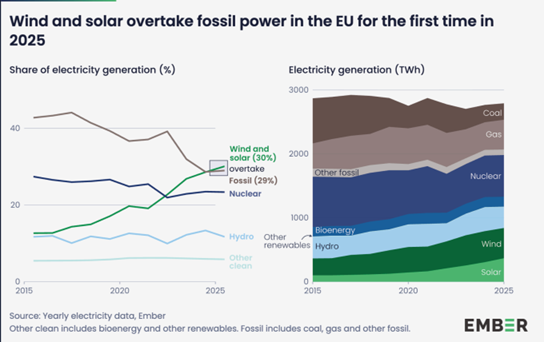
“In 2025, the EU made a giant leap towards a clean energy system powered by wind and solar,” notes the European Electricity Review report from the think tank Ember. It adds: “Wind and solar generated a record 30% of the EU’s electricity, surpassing fossil generation for the first time.” Presented in aggregated form, these results place renewable energy at the forefront of low-carbon electricity generation in the European Union. However, this overall view masks a different reality when sources are compared individually. In fact, nuclear ranks first, ahead of both renewables and fossil fuels.
Wind and solar surpass fossil fuels for the first time, yes…
In its latest report, the think tank highlights that “renewable energy provides nearly half of the EU’s electricity.” Wind has become the second largest source of electricity generation, accounting for 17% of total electricity produced in 2025. Taken together, solar and wind power exceed electricity generation from coal, oil and gas, representing 29% of electricity production. Crossing this threshold sends a strong signal about the momentum underway in the European energy transition.
…but nuclear did it earlier and remains in the lead
This development does not challenge the hierarchy of electricity sources when they are considered individually. Neither wind nor solar surpass nuclear power. Since 2023, nuclear energy has once again become the largest low-carbon source of electricity in the European Union, after having long been neck-and-neck with coal and then gas before the sharp decline of these two fossil fuels.
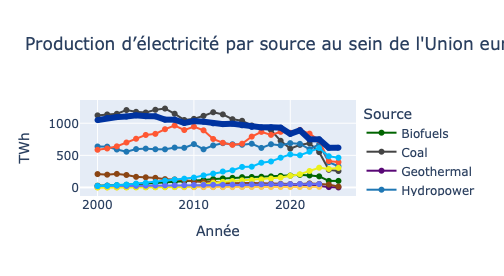
In 2025, nuclear power generated 618.47 TWh, representing 23.5% of total electricity production in the European Union. On its own, it significantly exceeds electricity generated from gas (394.37 TWh), coal (256.11 TWh) and oil (14.21 TWh). France plays a decisive role in this result, accounting on its own for nearly 60% of nuclear electricity generation in the European Union.
Technological neutrality: a condition for the transition and sovereignty
Overall, low-carbon electricity sources — nuclear, hydropower, wind and solar — represented 71% of electricity production in the European Union in 2025. This unprecedented level highlights that the decarbonization of the power system relies on the complementarity of technologies rather than on their opposition.
Technological neutrality therefore appears as a key principle for accelerating the energy transition while ensuring security of supply and European industrial sovereignty. In this perspective, relying on electricity generation sectors that are largely European constitutes a major strategic issue for the Union. ■
By Floriane Jacq, Sfen
Image: © Sfen