
SMRs: what European funding is available to move from innovation to deployment?
Europe is strengthening its support for nuclear innovation. European programmes such as Horizon Europe, the Innovation Fund, Euratom, and financing from the European Investment Bank offer a range of tools to support research, development and the commercialisation of small reactors. However, between technical criteria and intense competition, accessing these funds remains complex for startups in the sector.
At the end of January 2026, the French Directorate-General for Energy and Climate (DGEC) organised a seminar on European funding instruments dedicated to innovation and research and development. Financing small nuclear reactors remains a major challenge for startups. Strong European support is therefore essential. Guillaume Bouyt, Deputy Director for the Nuclear Industry at the DGEC, recalls that “being active with European authorities is one of the conditions for success for these companies.” For innovative nuclear players, however, this support takes the form of several European instruments with very different approaches and levels of technological maturity.
1. Horizon Europe
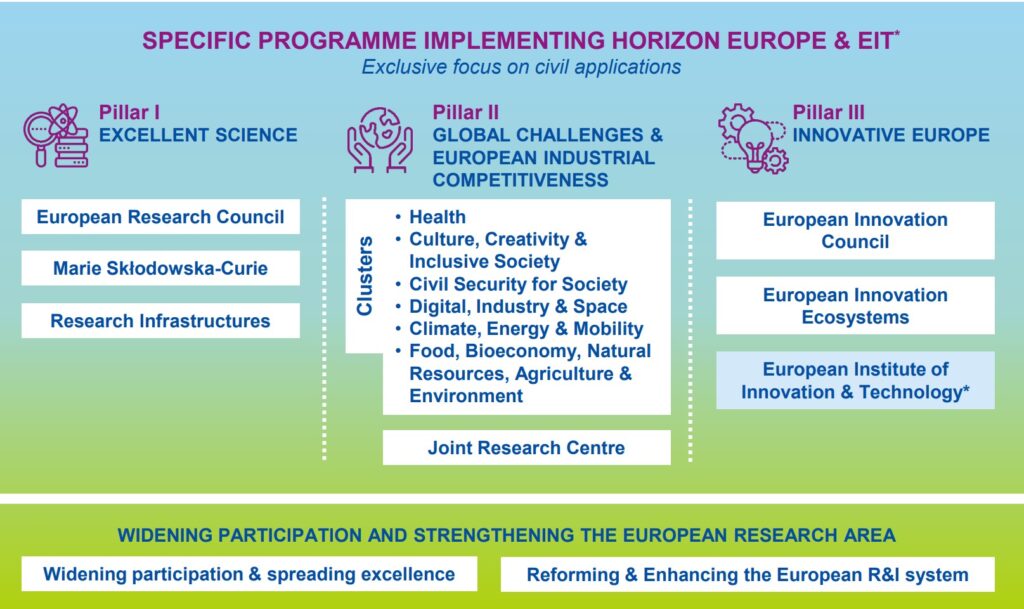
This is the European Union’s main funding programme for research and innovation. It has a budget of €95.5 billion for the 2021–2027 period. The programme is organised around three pillars. “There are currently no dedicated calls for nuclear projects,” notes Massimiliano Picciani, sector specialist for Ecotechnologies and Low-Carbon at Bpifrance. Nuclear-related projects may nevertheless be eligible under calls dedicated to industry. “Competition is extremely strong,” Picciani warns.
2. Euratom Fission Research
This programme complements Horizon Europe and is dedicated to nuclear research and innovation. It had a total budget of €1.38 billion for the 2021–2025 period. It covers research and development activities in fusion (€583 million), fission, nuclear safety and radiation protection (€266 million), as well as nuclear activities carried out by the European Commission’s Joint Research Centre (€532 million).
3. Innovation Fund
According to its own description, the Innovation Fund is “one of the world’s largest funding programmes for the deployment of innovative net-zero and low-carbon technologies.” The fund aims to support companies investing in clean energy and to help commercialise technologies capable of decarbonising European industry while strengthening its competitiveness. In December 2025, the European Commission launched the Net-Zero Technologies 2025 call with a total budget of €2.9 billion. Many sectors are concerned, including renewable energy, industry, residential energy use and road transport. Nuclear is eligible under the industry category because it is considered an industrial technology contributing to decarbonisation. “Small reactors are the most legitimate candidates,” notes Fabien Delafalize, innovation coordinator at the DGEC. The fund can contribute to both investment and operating costs, covering up to 60 percent of eligible expenses.
4. The European Investment Bank (EIB)
“Nuclear projects have always been eligible for financing from the European Investment Bank,” recalls Benjamin Bitaille, loan officer at the EIB.
While the European institution supported nuclear power plant construction between 1958 and 1977, it remained absent from such projects for several decades afterwards.
This position has evolved with the bank’s 2024–2027 roadmap, which confirms the return of nuclear energy within its scope of intervention. The EIB plans to support industrial alliances, particularly around SMRs, as well as the technologies covered by the Net Zero Industry Act: the nuclear fuel cycle, lifetime extensions of reactors, SMRs and AMRs, and large-scale nuclear power.
By explicitly referencing the Net Zero Industry Act, the bank goes beyond its historical caution and more clearly affirms its role in the development of the nuclear sector, in line with the Euratom Treaty.
In practice, the EIB has already begun this shift. In 2023, €145 million was granted for Europe’s first tritium extraction facility in Romania. In 2025, the bank financed the modernisation of the Olkiluoto nuclear power plant in Finland with €90 million and granted a €400 million loan for the expansion of Orano’s enrichment plant at Tricastin in France.
Nuclear recognition still incomplete
Programmes supporting the development and innovation of small modular reactors have continued to expand. However, as Guillaume Bouyt points out, although the idea that nuclear energy is recognised as a low-carbon energy source contributing to emission reduction objectives alongside other energy sources is gaining ground, “it has not yet fully matured.”
Nuclear energy was included in the European green taxonomy in February 2022, but only as a “transitional energy,” alongside natural gas.
Its classification as a transitional energy represents progress, but full recognition of nuclear as a low-carbon energy source remains an ongoing issue. ■
By Floriane Jacq, Sfen
Image: “SMR” text with small nuclear power plant icons on a natural background.
© Wasanajai