
EPR2 programme: a €72.8 billion cap for the first six reactors
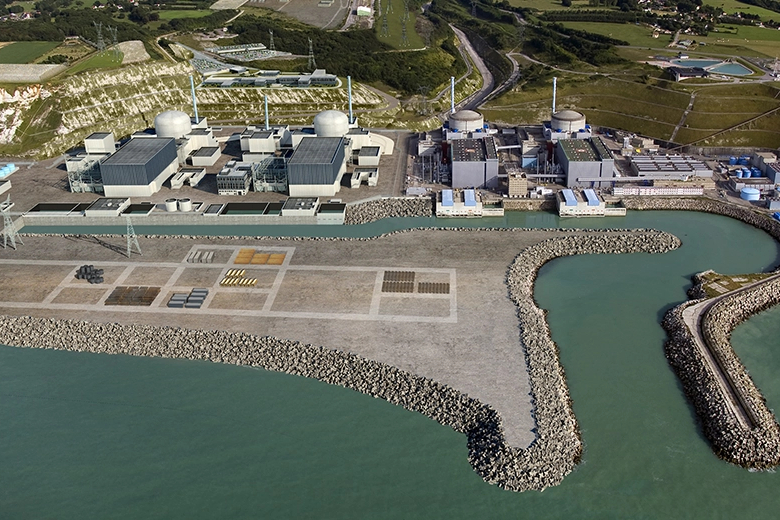
Maximum cost estimate, Final Investment Decision (FID) expected by the end of 2026, and first nuclear concrete scheduled for March 2029… EDF detailed the development conditions of what it calls the “project of the century” on Thursday, 18 December, following the validation by its Board of Directors of the preliminary cost estimate for the first six EPR2 reactors.
€72.8 billion (2020 value). That is the maximum cost announced by EDF for the first three pairs of French EPR2 reactors during a conference held on Thursday, 18 December. This preliminary estimate, validated by the Group’s Board of Directors, will be audited in the first quarter of 2026 by the Interministerial Delegation for New Nuclear (Dinn). This review is expected to result, by the end of March, in a cost estimate on which both the French State and EDF can formally commit. “This file is the result of work that mobilised all EDF teams involved in the programme, its subsidiaries and industrial partners, and it marks a new milestone for the EPR2 programme and for the revival of nuclear energy in France,” said EDF CEO Bernard Fontana in a post on LinkedIn.
Compared with previous estimates published by the Cour des comptes in January 2025, this represents an increase of €5.4 billion (2020 value) in overnight construction costs (excluding financing costs). “This increase stems in particular from the level of risk provisions included in the programme, which ensure our ability to absorb construction uncertainties and challenges,” explained Xavier Gruz, Executive Director in charge of setting up the future owner’s engineering organisation for new nuclear projects. “It is also a sign of the programme’s maturity, as it is now fully framed and closely monitored.” A similar message came from France’s Ministry of the Economy and Finance (Bercy), which stated in a press release that “EDF is beginning to gain greater visibility on its cost estimates.”
This €72.8 billion figure should also be viewed in the broader context of major energy transition investments, such as the modernisation of electricity transmission and distribution networks — estimated at €100 billion for RTE (France’s transmission system operator) and Enedis (the distribution system operator) by 2040. As the EPR2 programme for the first six units will span roughly 20 years, it represents an average annual investment of €3.64 billion, to be compared with France’s annual €50 to €110 billion fossil fuel bill.
A cap and a buffer
EDF further clarified that this new estimate represents a maximum cost for the three EPR2 pairs. On the one hand, the Group hopes it will not need to draw on the full amount of the cost provisions, which act as a “safety buffer.” On the other hand, EDF is relying on series effects to improve economic efficiency over the course of the programme. “Between the first and the last unit, we expect to achieve a 30% reduction in unit costs,” Xavier Gruz noted — a figure also highlighted by Bernard Fontana in his public communications.
These series effects are also logically reflected in the forecast construction timelines for the different units, and with considerable ambition. Between the first and the last EPR2 built, the lead time could be reduced by 32 months. Overall, EDF has updated its projections by drawing on experience from recent large nuclear projects. “Without any major technological changes, we have managed to reduce the target construction duration for a generic unit to 70 months, compared with 96 months three years ago,” said Thierry Le Mouroux, Executive Director in charge of Projects and Construction. This significant improvement stems from in-depth work carried out by EDF to optimise the learning curve of teams involved in EPR2 construction projects.
Learning from the best examples
First, EDF turned to the current leader in nuclear reactor construction: China. “We have built close cooperation with Chinese partners, including by immersing some of our teams directly on construction sites,” EDF executives explained.
Another key partner in improving schedules is the United Kingdom, through the Hinkley Point C and Sizewell Cprojects. In this context, EDF aims to capitalise on the 500 French workers currently active on the Hinkley Point C site. “Several British staff have also begun joining EDF for EPR2 projects, mainly individuals who worked on early construction phases such as civil engineering or site organisation,” Xavier Gruz specified.
These collaborations have led to improved construction planning, particularly through the optimisation of overlapping work sequences, enabling several projects to be carried out in parallel. In addition, EDF has launched several internal initiatives. A civil engineering working group has been operating for seven months, and a new organisational structure has been implemented to clarify roles and responsibilities.
With all these improvement factors combined, EDF estimates that the first EPR2 unit at Penly should enter service in 2038, with first nuclear concrete planned for March 2029. Subsequent reactor start-ups are expected to follow at intervals of 12 to 18 months. To concretely validate the continuation of the programme, EDF’s Board of Directors also approved a €2.7 billion budget allocation for the EPR2 programme in 2026, allowing further studies and preparatory works to proceed.
EDF also indicated that it hopes to reach a Final Investment Decision (FID) for the programme by the end of 2026. This milestone is subject to approval by the European Commission of the French State support mechanism for the EPR2 programme. EDF notes that France submitted its plan to the European executive on 19 November 2025, drawing heavily on the mechanism implemented in the Czech Republic for the Dukovany nuclear power plant. “Building on an existing model helps limit risks and therefore reduces associated delays,” Xavier Gruz explained. The French State’s support measures include a preferential interest rate to finance around 60% of construction costs, a 40-year Contract for Difference (CfD), and a risk-sharing mechanism between the State and EDF. ■
By Simon Philippe (Sfen)
Image: EDF plans to pour the first nuclear concrete for the EPR2 lead unit at Penly in March 2029. ©EDF