
Maintenance, organisation, costs: seven key lessons from EDF’s report on nuclear load-following
Load-following, long seen as a well-managed flexibility feature of France’s nuclear fleet, is now changing in both scale and nature, to the point of becoming an industrial, economic and political issue. Initially expected by the end of 2025, EDF ultimately chose to wait for the publication of the third Multi-Year Energy Programme (PPE3) before presenting the conclusions of its report on the subject. Revue Générale Nucléaire highlights seven key takeaways from this work.
Three days after the government published the Multi-Year Energy Programme, EDF presented the long-awaited report on load-following across its generation fleet on Monday, 16 February. “This study aims to document the concrete effects of this practice on the operation of our generating units,” EDF explained in a statement, whether from an industrial, organisational or social standpoint.
The report is nevertheless only a first step in a broader effort. “Work has been launched to establish a consolidated approach and an overall cost assessment of the electricity system. EDF is contributing, drawing on the analyses and lessons from the load-following report,” the French utility explains.
Here are seven key takeaways.
-
Load-following needs are increasing
While the ability to modulate output is fully integrated into reactor design, new dynamics have been at play for several years. “Between 2019 and 2024, nuclear load-following volumes doubled, rising from around 15 TWh to more than 30 TWh.”
This increased load-following is mainly linked to a situation of electricity overproduction in France, while consumption remains sluggish. The context is driven by rapid growth in solar capacity (plus 3 to 5 GW per year between 2019 and 2024) and wind capacity (plus 1 to 2 GW per year over the same period).
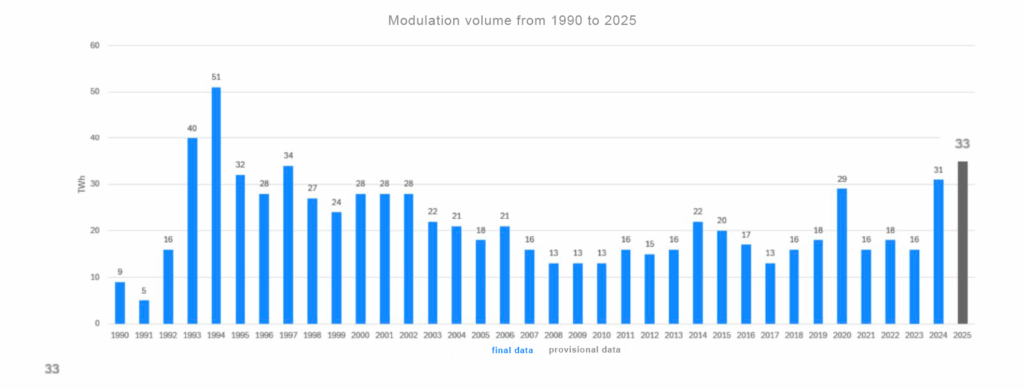
The year 2024 marked a turning point, with 31 TWh of load-following, including around 13 TWh due solely to a lack of economic outlets. Electricity market dispatch prioritises generating units with the lowest variable costs. Solar and wind are therefore dispatched first, followed by nuclear, then fossil thermal generation or hydropower for balancing.
EDF expects this situation to continue. Its simulations estimate a load-following requirement of 42.5 TWh in 2028, assuming moderate demand growth. In 2025, nuclear reactors performed 33 TWh of load-following.
-
Load-following is changing in nature
EDF says the phenomenon differs significantly from earlier periods. The volume of modulation through power reductions, and even more through shutdowns, has doubled compared with 2014 to 2023 and tripled compared with 2004 to 2013.
In addition, the intraday pattern of modulation has changed. The “solar bell curve” now creates a production peak between 11 a.m. and 5 p.m., on top of the historical need for night-time flexibility.
“Load-following is not new, but it is changing in nature. EDF masters the principle, but its current scale calls for collective mobilisation, both industrial and national, to guarantee a safe, efficient and sustainable electricity system,” commented Cédric Lewandowski, Director of EDF’s Nuclear and Thermal Fleet, in a LinkedIn post.
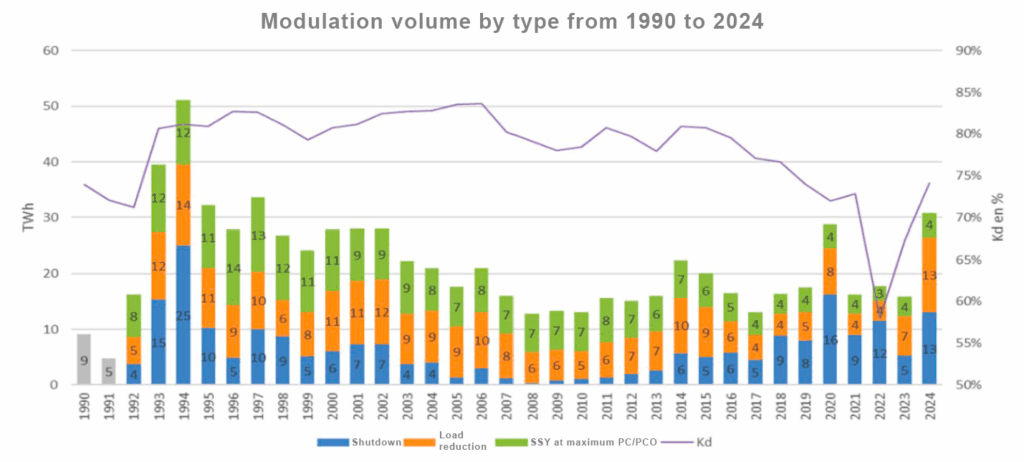
*SSY refers to a power reduction to provide System Services (SSY) to the grid operator.
Each reactor can reduce output from full power down to 20 percent in roughly 30 minutes. “When power reductions are not sufficient, short shutdowns are necessary. However, for neutron control reasons within the core, a shutdown during a fuel cycle cannot be shorter than 24 hours,” the report notes.
-
Reactor technical management must adapt
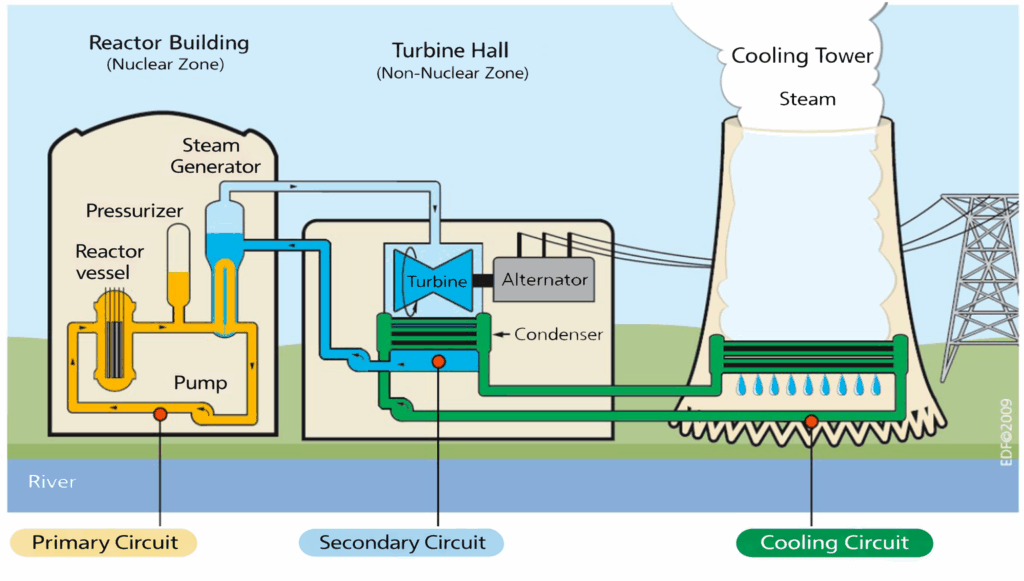
The report indicates that the impacts of load-following are mainly observed on the secondary side of the plants. EDF nevertheless recalls that the design of nuclear steam supply systems incorporates only a limited number of parameter variations that induce mechanical stress.
“It is therefore necessary to ensure that projections regarding the counting of operating situations and the reaching of limits, as calculated today, are not altered by increased load-following,” EDF stresses.
Fuel management is also addressed. Over the past three years, EDF has observed “an increase in reactors ending their fuel cycle with a low operating margin at reduced power with control rods inserted.” This reflects longer operation at intermediate power levels and could become a limiting factor for manoeuvrability.
This new fuel management approach can reduce optimisation, leading to under-use of fuel in the core, shifts in unit outage schedules, and mismatches between required production and demand. “Even though levers exist to optimise outage scheduling, the consequences for outage programme organisation are significant,” EDF notes.
-
Physical impacts are concentrated on the secondary circuit
EDF lists several secondary-circuit components that are, or could be, affected by increased load-following:
- AHP and GSS systems: cracking has been reported. Replacement of six reheaters is scheduled, and replacement is being considered for eleven additional pieces of equipment, for a total cost of €136 million.
- Heat exchangers: impacts have been identified but remain difficult to quantify. EDF expects increased inspections, maintenance, and possibly accelerated replacement of components.
- Turbines: replacement of low-pressure casings on 13 shaft lines for the CP0 and CP1 series would eliminate confirmed wear effects attributed to load-following, for around €1.4 billion. For other series, replacements are not planned at this stage. If they were to take place, the cost would be €800 million to €1 billion for the CP2 series and around €500 million for N4 units. Studies are under way for the 1,300 MW series.
- Steam admission components: full inspections every six years (instead of ten) for low-pressure sections, adding €30 million per year. A €10 million study is also planned on controlling material degradation mechanisms.
- Generators: acceleration of replacement or rewinding programmes, increasing routine maintenance costs by 10 to 25 percent (€1.5 million to €3.7 million per year).
- Main feedwater pumps (TPA): additional spare-parts costs to maintain full manoeuvrability, around €2 million per year for the 1,300 MW series and €1 million per year for the CP2 series.
- Steam generators: no correlation has been identified between load-following and fouling rates. However, EDF considers it possible that preventive cleaning frequency will need to increase, raising routine maintenance costs by 10 percent (plus €15 million to €20 million per year).
“From an industrial standpoint, more frequent sequences of load variations and shutdowns and restarts accelerate wear on several pieces of equipment, particularly in the secondary circuit, and increase maintenance needs,” Lewandowski wrote on LinkedIn. EDF plans to consolidate the underlying data further.
-
Work organisation is being reshaped
“Operational teams are also affected. Power variations are sensitive activities that require preparation, training and coordination,” continues Cédric Lewandowski. Their increasing frequency, often with little notice, disrupts schedules, increases out-of-hours interventions and can complicate maintenance activities that require extended reactor stability.
EDF says operator competency build-up and retention are ensured. However, the frequency of load-following can create challenges for reactor control and for compliance with technical operating specifications for the 900 MW series.
EDF is also developing an operational support tool, described as “a clear lever to facilitate preparation of transients,” with a €4 million budget. Additional staffing needs remain to be clarified, but EDF already estimates that one additional person per unit would represent around €5 million per year for the fleet as a whole.
-
Chemistry and effluents are affected
Nuclear reactors use various chemical reagents, including lithium hydroxide, boric acid and zinc acetate. Greater manoeuvrability will lead to increased consumption of these products in the primary circuit. EDF estimates the additional cost at around €50,000 to €270,000 per unit per year, representing a maximum increase of €15 million per year for the fleet.
“In the event of load variation, the volume of secondary-circuit water requiring conditioning remains broadly the same. No specific difficulties are expected or observed in achieving the conditioning target,” the report states.
Another point of attention is effluent generation. “Increased manoeuvrability will generate an increase in liquid and gaseous discharges and requires significant investment in water production systems and effluent treatment systems,” EDF explains.
These increases will likely require greater on-site storage capacity to limit discharges, particularly during periods when river flow constraints apply. EDF also stresses the need for treatment streams to scale up to support increased load-following. “An increase in treatment capacity may also be considered, which would imply significant investment,” the report notes. Longer shutdown durations are also expected to increase water consumption for the reactors concerned.
-
Other generation sources are also impacted
Initially intended to cover only nuclear, the work was ultimately extended to hydropower facilities and the thermal fleet. EDF notes that “cumulative operating time of pumped-storage hydropower plants (STEP) was significantly higher in 2025 than in previous years.”
On the thermal side, the number of shutdowns and restarts of combined-cycle gas turbine plants doubled between 2019 and 2024. Additional work is ongoing to assess the impacts of these operating pattern changes. “Initial estimates indicate that maintenance budgets could double,” the report states.
To limit the various effects of load-following, several solutions may be considered. In its statement, EDF considers that the main lever to reduce load-following remains accelerating electrification of end uses. A government plan on this subject is currently being prepared and should be published in the coming months.
Other avenues include better valorisation of the grid services provided by nuclear reactors (voltage support and inertia), new flexibility offerings, or reducing the pace of renewable energy deployment. ■