
Nuclear waste: Cigéo’s cost now estimated between €26 and €37 billion over 150 years
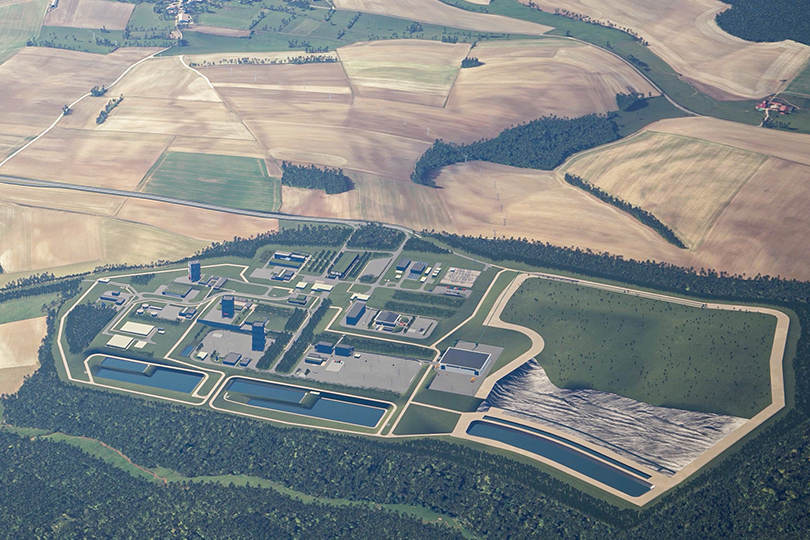
On May 12, 2025, Andra (France’s National Agency for Radioactive Waste Management) released its updated cost assessment for Cigéo, the deep geological disposal project for high-level (HLW) and intermediate-level long-lived radioactive waste (ILW-LL). The project’s total cost is now estimated at between €26.1 and €37.5 billion over a 150-year period. Subject to the issuance of the creation license decree by the end of 2027, the first waste packages could be received at the future disposal facility as early as 2050.
Cigéo (Industrial Centre for Geological Disposal) is an extraordinary long-term infrastructure project, extending far beyond a century and requiring sustained investment throughout its life cycle—from the earliest design studies to its closure and decommissioning. On May 12, 2025, Andra submitted a report to the Minister for Energy and Industry detailing the updated cost assessment. This new estimate revises the previous one from 2014 and covers the 150-year period from 2016 to 2170 (the anticipated date of final closure). The cost is now estimated between €26.1 and €37.5 billion [1]. This figure, expected to be formalized by decree by the end of 2025, will guide the continuation of the project until the next assessment. The report also indicates that the first waste packages could be received by 2050, assuming the current timeline is maintained.
A Cost Broken Down Into Several Components
Andra points out that “given the exceptional duration of the project and the absence of comparable examples, estimating the cost of Cigéo is a complex and unprecedented task.” Nevertheless, the estimate aims to be as realistic as possible and includes three distinct categories of expenses:
-
the cost of initial construction and commissioning of Cigéo;
-
the costs of operations, progressive construction, maintenance, life extension activities, and final decommissioning and closure (approximately 100 years of operations followed by 20 years of closure activities);
-
and the cost of research and development (R&D).
The estimate is based on a reference inventory of waste produced by existing nuclear facilities but does not include waste from future EPR2 reactors.
The first component involves investments related to the project’s initial design, preliminary works, construction, and commissioning of the first disposal modules. Here, Andra estimates a cost between €7.9 and €9.6 billion.
The second component covers the operation of the facility, maintaining it in operational condition, extending the site to accommodate the remaining waste packages, and its final sealing and closure. This would cost an estimated €140–220 million annually, adding up to a total of €16.5–25.9 billion.
The final component relates to R&D, including the operation and eventual closure of the underground research laboratory (where research on Cigéo has been conducted for decades). This is estimated to cost between €1.7 and €2 billion.
A Cost Subject to Variation
The total cost of Cigéo may vary significantly depending on three key factors:
-
Site Configuration:
The first factor is the site configuration ultimately selected. This could range from the “DAC” configuration (as submitted in the 2023 license application) to future optimized versions still under study. Depending on the chosen configuration, costs could decrease by up to €3.6 billion in the best-case scenario. -
Taxation Levels:
The second factor is the applicable level of taxation. One of the taxes affecting Cigéo has not yet been finalized, and the difference between the lower and upper thresholds—defined by the French code on taxes for goods and services (CIBS)—could result in a €7.4 billion variation in total cost. -
R&D Scope:
Finally, the scope of R&D activities, particularly regarding the closure of the underground lab, could shift costs by up to €0.3 billion.■
By François Terminet (Sfen)
Image: Artist’s aerial rendering of the Cigéo site. Source: Andra
[1] This global cost represents between 1% and 2% of the total cost of electricity generation from nuclear energy.