
[Decoding] How nuclear energy protects electricity consumers from the Iranian crisis
Faced with volatility in energy markets, nuclear power plays a central role in protecting consumers. Its high availability stabilises prices, while the Universal Nuclear Dividend ensures redistribution of revenues in the event of a prolonged crisis.
“Nuclear power is produced on our soil, and therefore provides independence. Wherever we supply energy, electricity produced from nuclear, we are independent,” declared the President of the Republic on Tuesday 10 March, during the Nuclear Energy Summit in Paris. The war in Iran and the recent rise in gas prices revive memories of the 2022 crisis, when the war in Ukraine led to a risk of gas supply disruption in Europe. At the time, the gas crisis also led to a sharp increase in electricity prices, due to the specific role played by gas-fired power plants on wholesale markets.
Is such a phenomenon to be feared today? Several factors indicate that electricity consumers do not, at this stage, need to fear a massive increase in their bills.
A different situation compared to 2022
Today’s gas crisis is of a much smaller scale. Europe imports less than 10% of its LNG from Qatar and the United Arab Emirates, and there is no risk of gas supply disruption comparable to 2022, when gas mainly came from Russia via pipelines. This is reflected in European natural gas futures prices[1], which, despite a 60% increase since early March, remain around €50/MWh, well below the €340/MWh reached in August 2022. At that time, gas prices no longer reflected the price of the molecule but the price of fear of supply failure.
In addition, France is currently in a situation of electricity abundance, with 547.5 TWh of electricity produced in 2025. In February, the government launched a national electrification plan to support industry, buildings, mobility and digital sectors. This plan may be one of the responses to the crisis: “Wherever we electrify our mobility to run on electricity produced domestically and decarbonised, we increase our independence and reduce the consequences of geopolitical shocks on our economies,” explained Emmanuel Macron during the Nuclear Energy Summit.
In 2022, France had produced only 445 TWh, due to the unavailability of several nuclear reactors (stress corrosion cracking) and lower hydropower generation (water levels in rivers and reservoirs below normal). France was a net importer of electricity for the first time in 40 years. In 2025, the nuclear fleet returned to its 2019 production level and reached record exports of 92 TWh.
As a consequence of high production and limited growth in consumption, wholesale prices[2] in February 2026 were particularly low at €46/MWh, below the full cost of nuclear generation, estimated by the Commission de régulation de l’énergie (CRE) at €60/MWh. As of 11 March, the “Calendar 2027” electricity futures contract, covering the whole year 2027, stood at €57/MWh. More generally, prices on the French market remain in 2026 significantly lower than in most neighbouring countries, with a gap of at least €30/MWh. The only exception is Spain, where forward prices are similar to those observed in France.
Consumers do not pay short-term wholesale prices
Households, as well as small businesses, companies and local authorities, benefit from a high level of price stability through fixed-price offers and regulated electricity tariffs (TRVE). These tariffs are set each year based on a proposal from the CRE. The current regulated tariffs were set on 1 February 2026 and their “energy component” will only change on 1 February 2027. Consumers who are not on regulated tariffs can subscribe to them at any time directly with EDF, or benefit from a market offer indexed to the regulated tariff or at a fixed price.
At this stage, nothing suggests a significant increase in regulated tariffs on 1 February 2027. Their construction method makes it possible to smooth the impact of sharp increases or decreases in wholesale markets. The supply cost (40–45% of the total excluding taxes), which reflects market conditions, is based on forward prices and calculated as an average over two years of quotations. It is estimated that the electricity needed for a given year is gradually purchased by suppliers on forward markets over a 24-month period. The tariff is therefore based on the average of these purchase prices, made at different times and spread over time. At this stage, for 2027, 14 months of quotations have already passed, and, as seen, prices have increased only moderately.
Companies contract market offers with their electricity suppliers, based on wholesale market conditions. Very large consumers can also buy directly on wholesale markets or conclude contracts directly with producers. Companies generally subscribe to multi-year fixed-price contracts, which protect them from market volatility. However, they remain exposed at the time of contract renewal, when prices are renegotiated: those whose contracts expire in 2026 can already compare available offers for the coming years and begin negotiations with suppliers.
Thanks to nuclear, French wholesale prices are less sensitive to gas prices
The electricity spot price is the price at which electricity is traded on wholesale markets for delivery the next day (day-ahead market). It is determined by a merit order mechanism: producers offer volumes of electricity with their variable costs, offers are ranked from lowest to highest, and the last plant called to meet demand sets the price. A spot price reflecting marginal production cost is a standard, appropriate and relevant signal for a commodity market.
As both sellers and buyers are risk-averse, they seek to secure their revenues or costs, which leads them to contract prices in advance for future years to avoid exposure to highly volatile spot prices. This underpins forward markets, whose prices reflect market participants’ expectations of future spot prices and their willingness to hedge price risk.
A forthcoming study by Aurora Research[3] for Sfen shows that nuclear sets the marginal price only 21% of the hours over the year, and variable renewables 3%. It should be noted that prolonged periods of low prices would not allow generation assets, particularly nuclear, to cover their full costs, especially fixed costs, on the market. Technologies positioned after nuclear in the merit order, such as gas or hydro storage (whose value is closely linked to gas prices), set prices most frequently. Domestic gas-fired power plants, which represent less than 5% of production in volume, determine the price around 40% of the time over the year. Foreign gas-fired plants do so 25% of the time via interconnections with neighbouring countries. This is not an indexation, but a more or less strong correlation.
The Aurora Research study shows, however, that French prices are less sensitive than those of its neighbours to a gas price shock. A 70% increase in gas prices would lead to a 50% increase in wholesale prices in France over the year, compared with 60% in neighbouring countries. It can also be noted that forward prices for 2027 have increased less in France (+€7/MWh between 27 February 2026 and 13 March 2026) than in Germany (+€12/MWh) or Italy (+€14/MWh). It can also be expected that, in the event of a prolonged gas price crisis, France, which currently benefits from very low prices and abundant electricity, would export more to its neighbours whose energy mix includes many gas-fired plants, or at least at higher prices.
A real advantage for France, in the event of a gas shock, would be that its electricity system production costs themselves, due to the share of nuclear and renewables exceeding 95%, would be barely affected. This is very different from neighbouring countries where gas-fired power plants account for a significant share of the electricity mix: 16% in Germany, 21% in Spain, and more than 45% in Italy.
French mechanisms to protect consumers
France has mechanisms in place to protect consumers in the event of a prolonged crisis with very high wholesale prices. In such a case, profits received by producers beyond the level necessary to remunerate their assets would be redistributed to consumers, via the new Universal Nuclear Dividend (VNU) mechanism for nuclear, and would benefit taxpayers through two-way contracts for difference for renewables.
The VNU mechanism aims to ensure redistribution of part of EDF’s revenues when they significantly exceed the full costs of its nuclear fleet. This approach is intended to stabilise prices for consumers, enable EDF to generate the resources needed to finance future investments, and preserve French industrial competitiveness.
The mechanism provides for taxation of EDF’s nuclear revenues when the average revenue of the nuclear fleet exceeds certain thresholds: 50% of revenues above the first threshold (approximately €78/MWh indicative), and 90% above the second threshold (approximately €110/MWh indicative). The CRE calculates EDF’s nuclear revenues each year to determine the share to be redistributed. The amounts collected, where applicable, are then distributed among all final electricity consumers (households and businesses) in the form of a reduction in electricity prices, visible on the bill as a specific line. As market prices are currently close to nuclear costs (approximately €60/MWh), it is unlikely that the VNU mechanism will need to be activated in 2026. ■
By Valérie Faudon, Sfen’s General Delegate
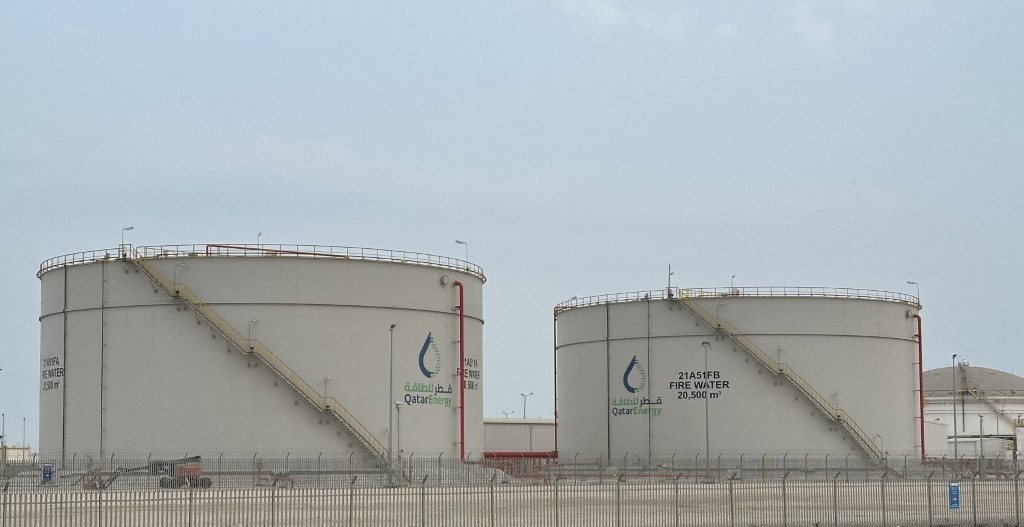
Image: QatarEnergy facilities are visible in the industrial area of Mesaieed, south of Doha, Qatar, on 5 March 2026.
[1] Trading Economics, Gas TTF
[2] Average day-ahead price
[3] French nuclear in the European power system, Aurora Research for Sfen, March 2026. Simulation 2026.