
Nuclear, exports and grids: RTE outlines France’s electricity equation

The recovery in nuclear generation is placing France in a favourable electricity position, with abundant and low-carbon electricity enabling significant exports to neighbouring countries. However, according to RTE, this advantage will need to be accompanied by increasing investments in grids in order to support the electrification of the economy and preserve the competitiveness of the power system.
“The Multiannual Energy Programme (PPE3) and international tensions show us the value of electrification. […] We must commit to investments that represent the greatest value for the country,” said Thomas Veyrenc. These investments are essential to enable France to maintain the advantage of competitive electricity. This is one of the key messages delivered by Thomas Veyrenc, Executive Director in charge of Economics, Strategy and Finance at RTE, during the presentation of its 2025 results and strategic outlook for 2026. According to him, however, achieving these objectives will require massive investments in electricity grids. In an uncertain geopolitical context, France can nevertheless look to the future with confidence thanks to a major asset: its nuclear fleet, which provides abundant, low-carbon and competitive electricity.
“2026 is not the same as 2022,” reassures Thomas Veyrenc. At the height of the gas crisis, 2022 was also explained by production issues within the fleet. Today, “there is no risk on that front” thanks to the recovery in nuclear generation. In 2025, it reached 373 TWh. France is therefore in a comfortable position, with abundant low-carbon electricity that makes it less exposed to gas prices compared to its neighbours. The country is also exporting large amounts of electricity at very competitive prices. The level of exchanges even “came close to the interconnection record of 20 GW,” recalls Thomas Veyrenc.
The electrification challenge
However, there is still ground to cover. RTE points out that electricity accounts for 27% of France’s energy consumption, while fossil fuels represent 60%. France therefore remains exposed to certain dependencies. “The crisis in the Middle East shows the value of electrification,” notes Thomas Veyrenc. This requires, according to RTE, a crucial increase in investment in the French electricity grid. “2025 is a year of rising investment,” explains the Executive Director. Investments reached €3.346 billion in 2025, more than double the level of 2021. “These investments may seem significant, but they remain lower than those of our European neighbours,” he states.
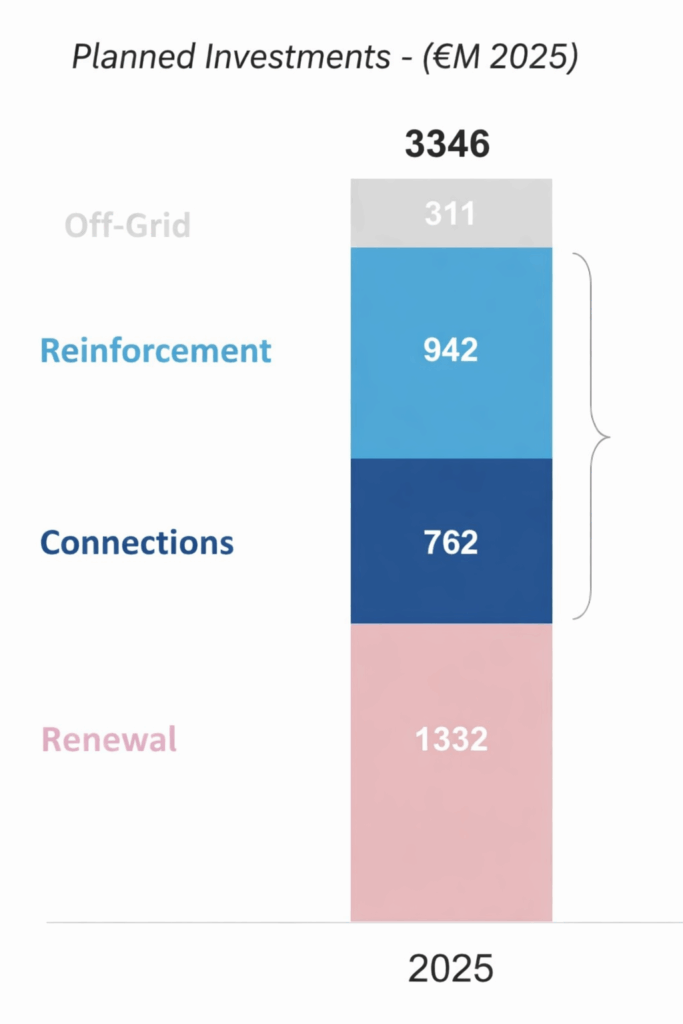
The renewal of the grid is the main area of investment, representing 40% of the total amount. This is 17% more than in 2024. This choice is explained by the age of French infrastructure compared to other European grids and by the need to adapt it to climate change. “We have every interest in maintaining it very well to make it last as long as possible and to remain a competitive transmission system compared to our neighbours,” he warns. RTE announces an investment trajectory for 2026, with an investment programme of €4.239 billion. For 2026, the objective is to continue increasing investments in grid connections and reinforcements for consumers. For Thomas Veyrenc, “this is the number one priority.” 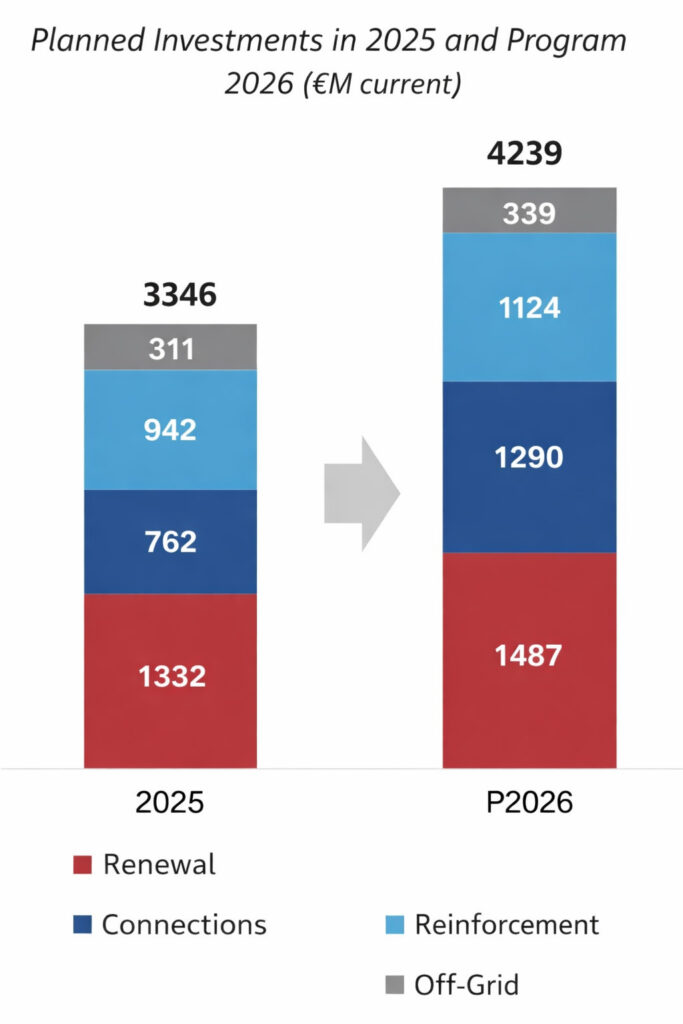
■