
SMRs: DAC submitted, Stellaria looks ahead
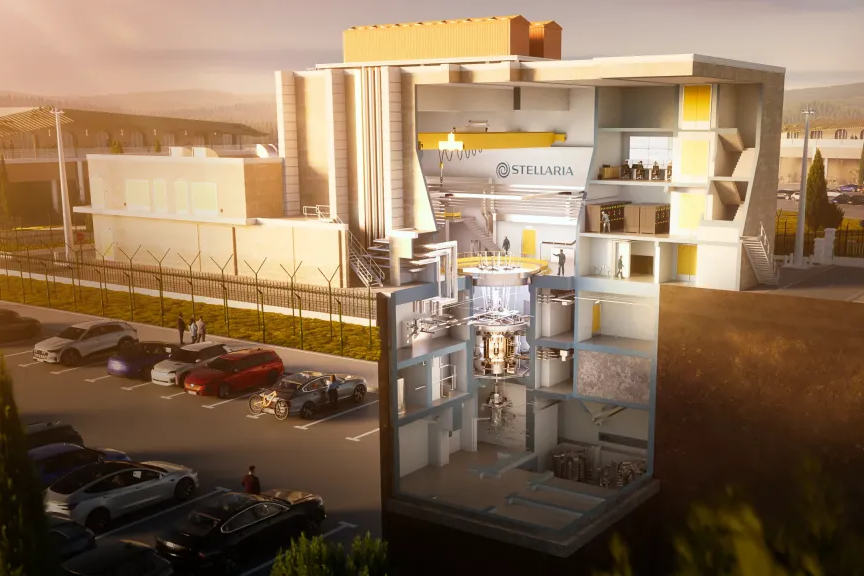
As the second SMR developer to submit an Application for Construction Authorisation (DAC) to France’s Nuclear Safety and Radiation Protection Authority (ASNR) for a basic nuclear installation, Stellaria has reached a major milestone. The next targets: a significant funding round in 2027 and a first reactor divergence in 2030 or 2031.
Two down. Eighteen months after Jimmy, SMR developer Stellaria has submitted its Application for Construction Authorisation (DAC) to the French authorities. A first for a molten salt fast-neutron reactor. “This is a major event for us, and it rewards two years of intense work,” says Nicolas Breyton, President and founder of Stellaria, speaking to RGN. “By submitting this application, we are moving beyond the concept stage and entering a structured regulatory phase, in which the fundamental design choices are now fixed.”
This DAC submission follows a series of technical and preparatory exchanges with the Nuclear Safety and Radiation Protection Authority (ASNR). To support the development of SMRs in France, the nuclear regulator has established a progressive four-step support framework, culminating in the formal review of a DAC. Stellaria reached this final stage on 19 December 2025, when ASNR received a copy of the application, followed by a formal referral by the Mission for Nuclear Safety and Radiation Protection (MSNR) to officially initiate the review process.
Safety as the central focus
The DAC covers the siting and installation of Stellaria’s Alvin prototype at the CEA-owned Cadarache site. “This small reactor, with a core roughly fifty centimetres in length and width, will allow us to demonstrate the intrinsic safety of the technology,” explains Nicolas Breyton. With a thermal capacity of 100 to 200 kWth, the demonstrator will operate for about one month, long enough to collect the necessary data. “We hope that the admissibility of the DAC will be approved by ASNR in the coming months, which would allow us to envisage first divergence in 2030 or 2031,” he adds. Between these two milestones, Stellaria plans to carry out a major fundraising round in 2027. As a reminder, the start-up, spun out of CEA and Schneider Electric, completed a €23 million funding round in July 2025. The installation at Cadarache will also make it possible to advance work on the manufacture of plutonium-based molten salts, which will serve as fuel for the SMR.
Stellaria specifies that the application includes around fifteen documents, totalling more than 1,000 pages. These cover the full safety demonstration, including analyses of incidents and accidents, protection against external hazards, and radiation protection for workers, the public and the environment, as well as the environmental impact assessment and the technical and financial capabilities of the operator.
Scaling up
Alvin represents only the first step in the start-up’s development roadmap. Once the safety demonstration has been validated, Stellaria plans to replace the reactor vessel to convert it into a prototype of around 10 MW, known as MegaAlvin. This second version aims to achieve three objectives: gather new data at higher power, provide several years of operational feedback ahead of the first-of-a-kind reactor, and build up team competencies. “This test reactor will likely operate for 20 to 30 years and should provide a technological sandbox not only for Stellaria but for the entire fast-neutron reactor sector,” estimates the company’s president.
While Stellaria appears to be on track, Nicolas Breyton calls on the French government to provide stronger support to this emerging sector. As a winner of the ‘Innovative Nuclear Reactors’ call for projects, the start-up is hoping for an ambitious second phase. “It is time for the State and the established nuclear industry to become more deeply involved in creating national champions. To build a French industry, innovation must be freed up and projects must be supported throughout their growth,” he argues.
At present, Jimmy is the only other start-up to have reached the final stage of ASNR’s support process, with its 20 MWth high-temperature reactor. The French company submitted its DAC in May 2024 for a reactor intended to supply industrial heat to a Cristal Union group facility in Bézancourt. Following an initial review, ASNR and MSNR requested additional information from Jimmy. The company is expected to submit these additional elements by March 2026, enabling the review process to continue. ■
By Simon Philippe
Image: The Alvin prototype will have a thermal capacity between 100 and 200 kWth. © Stellaria