
With ArcelorMittal, EDF continues to expand its long-term contracts
ArcelorMittal has joined the still small but growing group of industrial players that have signed a Nuclear Production Allocation Contract (CAPN) with EDF (Électricité de France). Since the last quarter of 2025, the French utility has recorded a rise in the signing of this type of long-term contract, as ARENH comes to an end.
Two years after its letter of intent, ArcelorMittal has taken the next step. In early January, the industrial group announced that it had signed a CAPN with EDF, granting it access to a share of the output of the French nuclear fleet for a period of 18 years. “This agreement will allow us to supply our French sites over the long term with low-carbon electricity, a key factor for the future competitiveness of the steel produced in France,” said Reiner Blaschek, Chief Executive Officer of ArcelorMittal Europe, in a statement published on 6 January.
This announcement comes amid an acceleration in CAPN signings, against the backdrop of the end of ARENH on 1 January 2026. At present, the public utility counts 19 long-term contracts, including 12 CAPNs, EDF told Revue Générale Nucléaire. In September 2025, the company listed only 4 firm contracts and 11 letters of intent. Other CAPN signatories include Belgian chemical company Tessenderlo, cement producer Vicat, data centre operator Data4, and construction materials specialist Lafarge. Verkor, a designer and producer of low-carbon batteries for electric vehicles, has also signed a CAPN, covering deliveries from 2028 of a 33 MW share of nuclear capacity. The 19 long-term contracts are expected to supply around 19 TWh per year to their signatories, EDF said.
A condition for decarbonisation
For ArcelorMittal, this CAPN is a key competitiveness lever at a time when the sector is under severe pressure. The European steel market has deteriorated, shrinking from 160 million tonnes in 2008 to 121 million tonnes in 2024, undermined by global overcapacity. To secure its French operations, ArcelorMittal plans to decarbonise its production facilities, for example by deploying an electric arc furnace at its Fos-sur-Mer site. In a project study, the group stresses that “access to decarbonised electricity at a competitive price over the long term” is one of the necessary conditions for transforming its activities. “Fair international competition, supported by a stronger EU trade policy and an effective Carbon Border Adjustment Mechanism (CBAM)” is also essential for the steelmaker, which is one of France’s largest energy consumers.
CAPNs are one of the mechanisms for accessing electricity produced by EDF’s historic nuclear fleet following the end of ARENH on 1 January 2026. With the termination of that mechanism, the Universal Nuclear Levy (VNU) now forms the basis for EDF’s marketing of nuclear-generated electricity. This system of redistributing revenues to consumers based on price thresholds is, however, complemented by more advantageous long-term contracts, mainly intended for electricity-intensive companies.
An expansion planned for 2027
CAPNs thus allow French electricity-intensive industries to secure electricity at a competitive price close to production costs, in exchange for sharing the costs and risks associated with French nuclear generation. Initially open only to electricity-intensive industrial users, EDF expanded the scope of CAPNs in November 2025 to a broader range of stakeholders: final consumers with annual demand exceeding 7 GWh, suppliers authorised by the French administration to purchase electricity for resale, and electricity producers. These new partners will receive their first electricity deliveries from 1 January 2027, with EDF making available a total volume of 1,800 MW, corresponding to around 10.6 TWh per year, based on annual production of 360 TWh.
The gradual unlocking of discussions between EDF and major French electricity consumers is partly the result of the strategy promoted by Bernard Fontana since he took the helm of the utility. “The arrival of Bernard Fontana has indeed led to a resumption of bilateral discussions between electricity-intensive industrial players and EDF, as well as developments moving in the right direction,” Nicolas de Warren, President of Uniden (the association representing electricity-intensive industries), told Revue Générale Nucléaire in September 2025. ■
By Simon Philippe (Sfen)
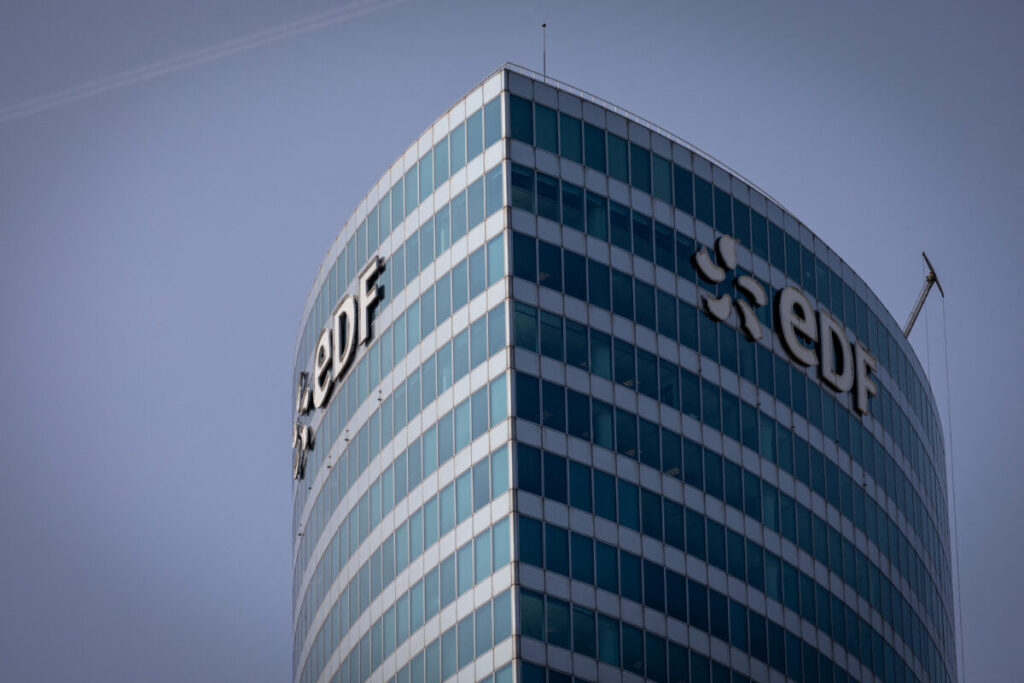
Image: EDF currently counts 19 long-term contracts, representing around 19 TWh per year of electricity. © Benjamin Polge / Hans Lucas