
COP30: 17 International Nuclear Associations Sign a Joint Commitment at WNE 2025
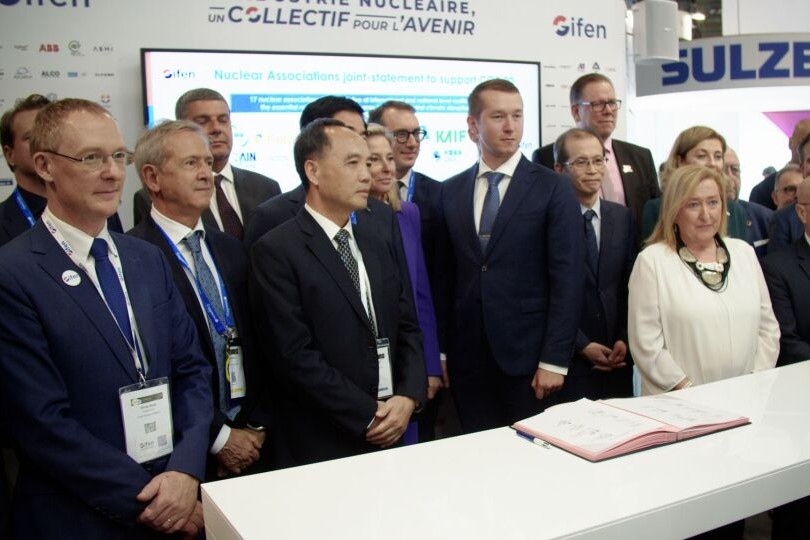
At the occasion of the World Nuclear Exhibition 2025 and COP30 in Brazil, 17 nuclear associations signed a joint climate declaration. This initiative highlights the essential role of nuclear energy in meeting climate goals, ensuring security of supply, and supporting industrial innovation worldwide.
During the World Nuclear Exhibition 2025 (4–6 November), and on the occasion of COP30 in Brazil, 17 national and international nuclear industry associations¹, representing 15 countries across three continents, signed a joint declaration for the climate. The initiative was led by Gifen, in partnership with the World Nuclear Association (WNA).
The objective? To reaffirm the contribution of nuclear energy to achieving climate targets, to strengthen security of supply with low-carbon, dispatchable electricity, to support skills and industrial value chains in Europe and globally, and to foster innovation and the deployment of solutions tailored to the needs of different regions.
#WNE2025 was packed with events, exchanges and actions for nucleareurope !
Discover nucleareurope’s highlights from the past three days, including participation in multiple events, official visits, signing ceremonies and bilateral meetings.
👉https://t.co/PzShfTjjfE pic.twitter.com/3HkivRKeYt
— nucleareurope (@Nucleareurope) November 7, 2025
Nuclear industry stakeholders also call on policymakers to uphold their commitment to triple global nuclear capacity by 2050, backed by stable public policies and appropriate financing. This commitment was first made at COP28 in Dubai by around twenty countries, joined by six additional nations at COP29. The objective is to reach 1,240 GW of installed nuclear capacity by 2050, compared to 413 GW in 2020.
Political commitments
In the presence of Monique Barbut, Minister for Ecological Transition, Biodiversity, and International Negotiations on Climate and Nature, the signing illustrates the commitment of the French and global nuclear industry to combating climate change by providing low-carbon, reliable, dispatchable energy. The initiative also sends a clear signal to policymakers of the sector’s willingness to invest within stable and predictable frameworks.
At the opening of the WNE, Rafael Grossi, Director General of the International Atomic Energy Agency (IAEA), reminded attendees that without nuclear energy, decarbonization would be impossible. He explained:
“Two years ago in Dubai, during the COP, for the first time the world acknowledged that nuclear had to be accelerated — not merely tolerated. We accepted its indispensable nature within the energy mix.” ■