
WNE 2025: Four key takeaways for a successful nuclear comeback
Nuclear energy is no longer a promise: it is back. The 2025 World Nuclear Exhibition outlined this comeback, confirming its central role in global energy and climate strategies. But this return relies on clearly identified levers — financing, industrialisation, standardisation and governance — which will determine the success of the sector’s revival.
From 4 to 6 November 2025, the World Nuclear Exhibition (WNE) confirmed a now unmistakable trend: nuclear energy is regaining a central position in global energy balances. But this “comeback” — far from automatic — depends on very concrete conditions: political decisions, financing models, industrialisation of the supply chain, its climate role, and European governance. The RGN followed the highlights of these three days live (day 1, day 2 and day 3). Let’s review the key moments.
The big return: from promise to realism
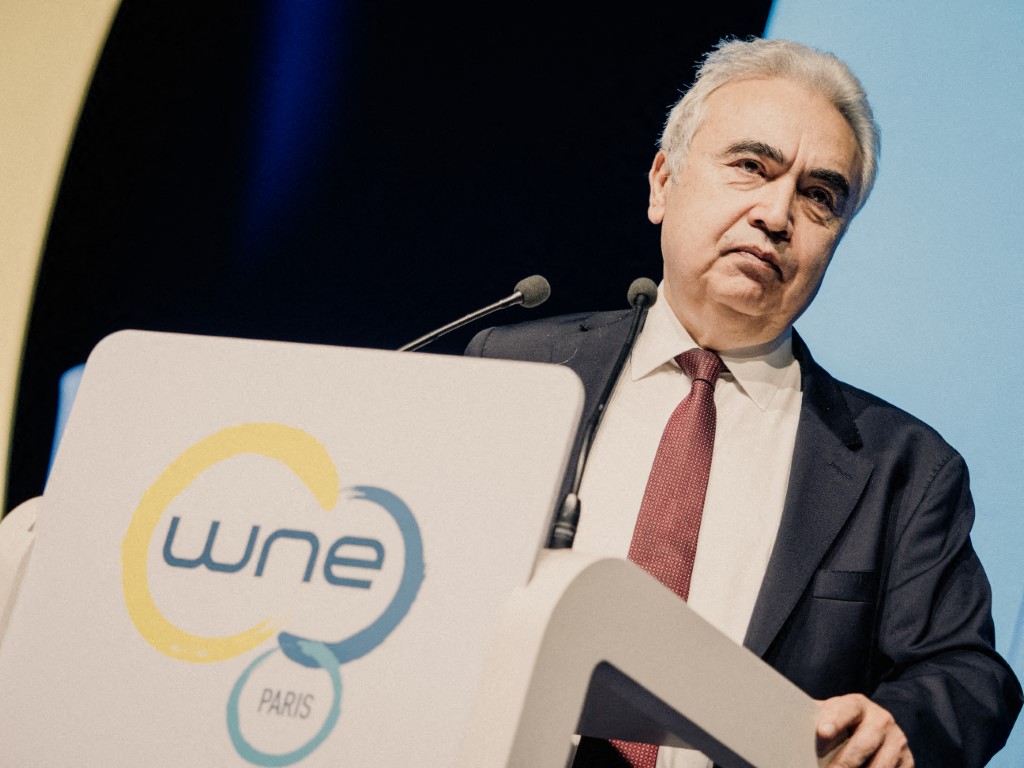
“Nuclear energy is back. Its return is now a reality,” said Fatih Birol, Executive Director of the International Energy Agency (IEA), during the WNE opening session. He recalled that the combination of rising electricity demand, a significant number of units under construction, and new candidate countries had made the nuclear comeback credible.
“We are moving from promise to progress: the sector is experiencing a return to realism as countries expand, launch or update their programmes,” added Rafael Grossi, Director General of the IAEA. He stressed that this realism now requires concrete action — not only declarations — to turn political intentions into tangible deliverables.
Financing: the decisive challenge
Financing was described as one of the main bottlenecks to resolve in order to convert political momentum into industrial achievements. WNE 2025 dedicated several sessions and roundtables to exploring “new ways” of financing the nuclear renaissance to keep pace with industrial and political momentum.
Investors need visibility on timelines, and a mix of instruments — public financing (guarantees, concessional loans), public–private partnerships, risk-sharing mechanisms, and long-term tools adapted to nuclear cycles — to reduce the cost of capital.
But the multiplication of first-of-a-kind (FOAK) projects in many countries increases the risk premium; panellists therefore called for public instruments specifically designed for these first units (grants, credit facilities, risk insurance). Stéphane Aubarbier, CEO of Assystem, insisted: “Financing is one of the dominant issues if we want to make a nuclear programme possible today.”
Supply chain and standardisation: from supply chain to value chain
The supply chain was a central thread throughout the discussions. EDF, Framatome, Vinci, Assystem and others stressed the need for early supplier involvement, harmonised standards, and long-term relationships between large groups and SMEs.
“We must move from a traditional supply-chain model to a long-term value chain,” said Bernard Fontana (EDF) during a panel on the supply chain. He urged the industry to learn from sectors like aerospace and automotive, where standardisation has driven operational excellence.
Standardisation is key. The more models and designs are standardised, the lower the technical and scheduling risks — which in turn lowers the return required by lenders. “China has demonstrated that replication and standardisation can deliver economic and time efficiency gains on nuclear reactor projects,” said Marc Duret, Head of Business Development and Sales at Framatome. “As Framatome is set to significantly increase its production capacity, we must draw inspiration from this proven model.”
“With this project (Sizewell C), we are already seeing the first benefits of standardisation,” added Bertrand Michoud, Executive Director of Sizewell C. “Having a stabilised design well before construction allowed us to de-risk the manufacturing of several components. Replicating the design was not guaranteed at the outset. It required significant effort regarding site conditions, regulatory phases, and across the supply chain.”
Climate: a central role in carbon neutrality
The WNE confirmed that nuclear energy is now considered by major institutions and ministers as central to decarbonisation strategies:
“Nuclear energy has moved from the margins of the energy debate to the heart of global climate action,” argued IAEA Director General Rafael Mariano Grossi. The event also highlighted the scale of the challenge: according to speakers, the pace of nuclear capacity additions must more than triple to meet certain carbon-neutrality scenarios.
“We will ensure that nuclear energy maintains its place among the solutions of the future, in order to meet the objective of tripling nuclear capacity by 2050,” said Sama Bilbao y León, Director General of the World Nuclear Association.■
By Ludovic Dupin (Sfen)
Image: Fatih Birol, Executive Director of the IEA – @BASTIEN OHIER / HANS LUCAS / HANS LUCAS VIA AFP