
The nuclear sector equips itself with a secure collaborative digital space
A consortium of six major players from the European nuclear and digital sectors has launched Data4NUclearX. The objective: to create a sovereign and secure digital space for the nuclear industry, as data exchanges are expected to increase tenfold within five years.
As in all industries, data has become a critical component of the nuclear sector. And with the revival of a programme to build six, then eight, EPR2 reactors in France, data security cannot be overlooked. In response to this challenge, six major European actors – EDF, CEA, Gifen, Institut Mines-Télécom, Dawex and Sopra Steria – have launched the Data4NuclearX programme. The aim of this project is to “create a sovereign and secure digital space for data exchange”, EDF explained in a press release published on 5 November.
Data exchange represents “a crucial issue in a context of nuclear expansion, where exchanges could increase tenfold within five years to reach an estimated 25 million data items exchanged each year”, the French company added. In this context, Data4NuclearX provides a solution to support the sector’s growing needs.
A benefit for the supply chain
Beyond data security, the project should also help the supply chain gain efficiency. “Among the first operational implementations are exchanges related to the monitoring of equipment manufacturing, enabling faster decision-making and shorter lead times,” EDF said. This should help improve quality, planning control and traceability.
The project is currently in a design and scoping phase that will run until 2027. This pilot phase, focused on the project’s three priority use cases, will be followed by a full operational deployment beginning in 2028. The programme benefits from State support through France 2030.
A tailor-made team
Each of the six partners has a specific role in the programme. EDF serves as project leader and coordinator. The CEA “contributes its expertise in data semantics and artificial intelligence to develop tools that facilitate partner integration, particularly for SMEs”. Gifen, for its part, brings together companies across the sector to advance project digitalisation.
Institut Mines-Télécom is involved in the prototyping and experimentation phase, particularly in supporting the scaling-up of the data space. The technological data-exchange solution is provided by Dawex. And Sopra Steria “brings its expertise in architecture and development alongside the other consortium members to design and implement the specific components required for the deployment of the data space”. ■
By Simon Philippe (Sfen)
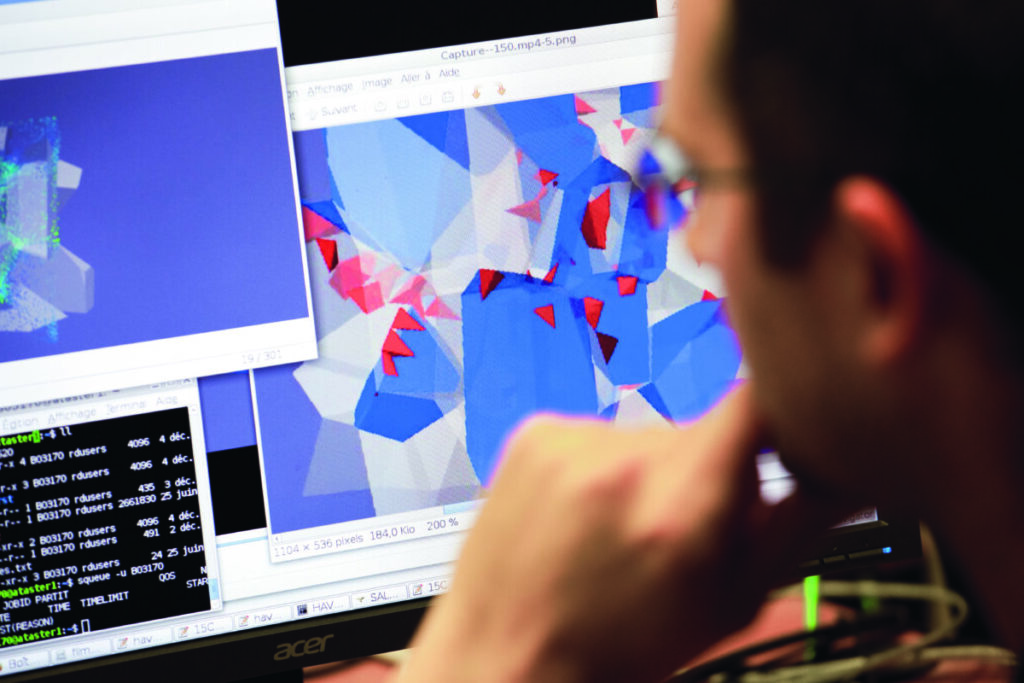
Photo: Laboratories of the MMC Department (Materials and Component Mechanics) at EDF Lab Les Renardières. Digital simulation laboratory. Credit: EDF R&D