
Match Report 2025: The French nuclear industry is hiring and confirms its industrial revival
With the third edition of the Match study, GIFEN confirms the positive effects of the nuclear revitalization program on the health of the industry. Since the beginning of the decade, workforce levels have increased by around 10%. This trend is also reflected in the sector’s economic forecasts for the coming years.
The effects of the French nuclear revival are visible through rising recruitment across the nuclear ecosystem. This is the conclusion of the updated Match report presented by the Groupement Industriel de la Filière Nucléaire (GIFEN) on Tuesday, October 28.
“The entire nuclear industry accounts for 247,000 jobs at the end of 2024,” notes Xavier Ursat, President of GIFEN. “Although it is difficult to compare this figure precisely with previous estimates, we observe a visible increase in full-time equivalent positions of around ten percent.” Nuclear power thus places itself among the three largest industrial sectors in France, alongside the automotive and aerospace industries.
As a reminder, when GIFEN presented the first Match report in early 2023, the industry estimated its number of FTEs at 220,000, including 125,000 highly technical direct positions—referred to as core target jobs. By the end of 2024, these professions represent 163,000 jobs. The sharp rise in workforce numbers can be explained both by current momentum and by improved data consolidation from GIFEN, which now includes the United Kingdom’s segment accessible to the French nuclear supply chain. Note that the workforce needs of SMR and AMR developers are not included in this study.
The beginning of a marathon
“We are at a unique moment for French nuclear, with a dynamic unlike the past 40 or 50 years,” analyzes Xavier Ursat. “This is part of a major nuclear revival essential to reaffirm the competitiveness of our territories and the energy sovereignty of France and Europe.” The momentum initiated in the first half of the decade is expected to continue.
GIFEN confirms the sector’s recruitment needs over the next 10 years at 100,000 FTEs, in order to reach a total of 300,000 FTEs by 2035. “Half of these future recruitments will support increased activity. The remaining 50% are intended to replace retirements and sectoral turnover,” notes Olivier Bard, GIFEN’s General Delegate. Two-thirds of hires concern technician-level roles, from vocational certifications to three-year post-secondary degrees, while currently 48% of workers in the sector are managers or engineers.
An uneven distribution
This anticipated workforce increase distinguishes two types of growth: one immediate and one delayed.
“To support the EPR2 program, we will have a rapid need for labor in civil engineering,” illustrates Olivier Bard. “The number of jobs dedicated to nuclear activities could even triple in the coming years.”
In contrast, the electromechanical assembly segment will require fewer human resources in the short term, with workforce needs expected to grow by about 20% between 2028 and 2032.
Another point highlighted by the study is the diversity of sector structures.
“The updated Match report identified 1,830 companies at the end of 2024, which should bring the actual number in the sector to around 2,000,” continues Olivier Bard. Although micro-enterprises and SMEs represent 91% of companies in terms of volume, they employ only 11% of the workforce. “Around 95% of nuclear workers are employed within the 600 GIFEN member companies,” estimates Xavier Ursat.
Rapid economic impacts
Unsurprisingly, the workforce dynamics within nuclear mirror associated economic investments. The forecasts of the sector’s seven major contractors—EDF, Framatome, Andra, CEA, Orano, Technicatome, and Assystem—show an increase in procurement of around 30% over five years compared to current levels. By 2035, this would represent a global order book of €162.5 billion.
“Our modeling identifies two workload peaks, in 2026 and then in 2032,” details Xavier Ursat. “They first illustrate the ramp-up of the EPR2 program, followed by the launch of the ‘Aval du Futur’ program.”
This third edition of the Match report highlights the creation of €30.5 billion in added value by the nuclear sector in 2023, including more than €7 billion in exports excluding electricity.
“Of this total amount, around €18 billion is allocated to employee wages and social contributions, and €2.6 billion to taxes,” notes Olivier Bard. However, this overall figure should be interpreted with caution, as it is highly influenced by electricity prices, with EDF representing approximately half of the value generated. ■
By Simon Philippe (Sfen)
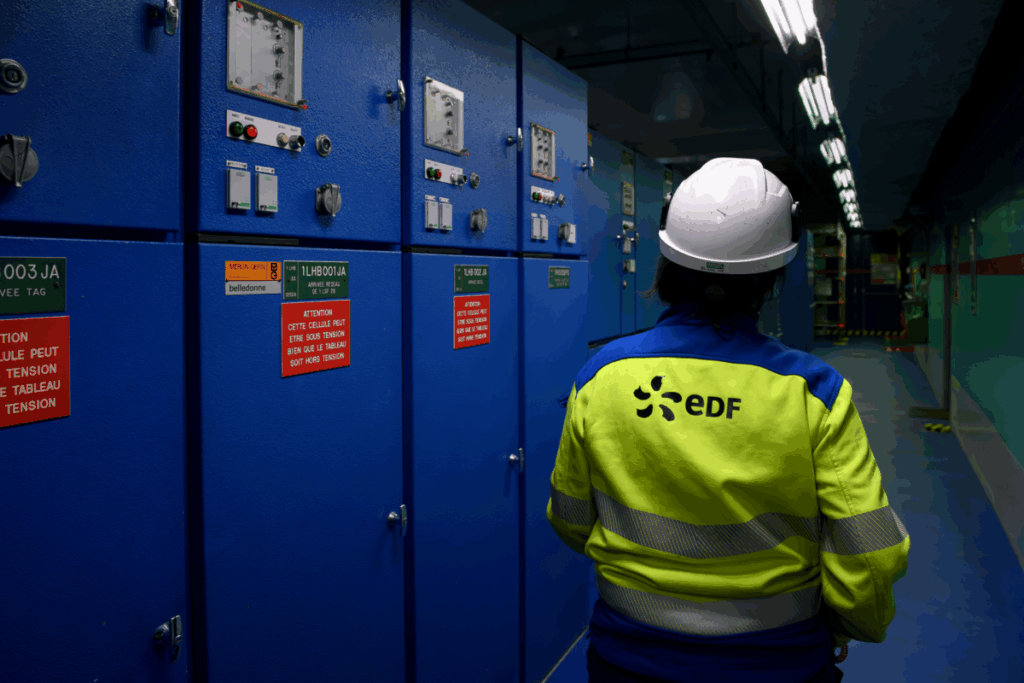
Photo: Interior view of the Flamanville 1 and 2 nuclear power plant. © Antoine SOUBIGOU / EDF