
[Nuclear by the Numbers] A €30/MWh gap with Germany: The competitiveness of french electricity
With the “Nuclear by the Numbers” series, the RGN sheds light on energy issues through key data. Today, let’s focus on wholesale electricity prices: thanks to the nuclear fleet’s recovery, France is offering significantly lower rates for 2026 compared to its neighbors—up to €30/MWh less than Germany.
Since the early 2020s, spot electricity prices in the European Union have been highly volatile, ranging from exceptionally high levels to, at times, negative values. This volatility stems from a mix of structural and short-term factors: the energy crisis triggered by the war in Ukraine, rising natural gas prices, and weather events impacting renewable electricity generation.
In France, this topic was addressed in a roundtable organized by the Finance Committee and the Economic Affairs Committee. Several key figures were heard, including Bernard Fontana, CEO of EDF; Emmanuelle Wargon, president of the Energy Regulation Commission (CRE); France Roubanovitch, president of CLEE (a large energy consumers’ association); and François Carlier, general delegate of CLCV (a consumer protection organization).
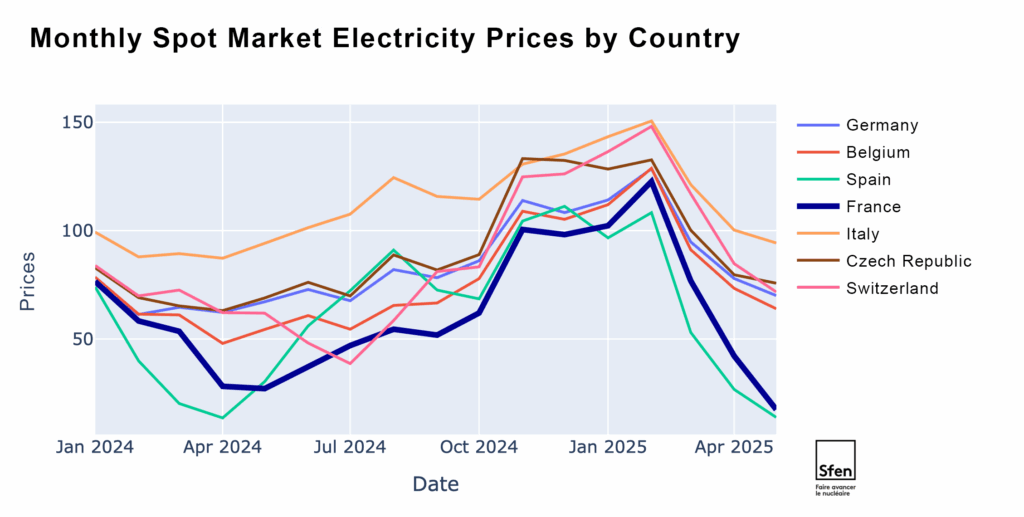
At the end of May, for 2026 electricity delivery, French companies were able to secure contracts at prices €26/MWh lower than in Germany and €40/MWh lower than in Spain. According to Bernard Fontana, since November 2023, wholesale prices available to clients looking to secure their bills for one to five years have dropped by 30% and returned to pre-crisis levels.
The graph below clearly shows that France has stood out in recent years with more competitive spot prices than other EU countries.
A Competitiveness Issue
Bernard Fontana maintains that French companies can sign electricity contracts under more competitive conditions than their European counterparts. Starting January 1, 2026, with the end of the Arenh mechanism, electricity bills will be fully exposed to market prices. The CRE president anticipates wholesale prices in France at €58/MWh in 2026 and €57/MWh in 2027. These relatively low levels are due to strong nuclear production availability and sluggish demand. In comparison, German prices are expected to reach €88/MWh.
Electricity prices are a key factor in the strategy to electrify end-uses. To support this trend, EDF is offering mid-term contracts (three, four, or five years), which are attracting growing interest. Over 10,000 such contracts have already been signed with companies of all sizes. For energy-intensive industries, Bernard Fontana has revived discussions around Nuclear Production Allocation Contracts (CAPN) to identify further flexibility.
Electricity Still Penalized by Unfavorable Taxation
However, the electricity bill for consumers on regulated tariffs only partially reflects the actual cost of electricity itself, which accounts for just about 40% of the total amount. The remaining 60% is split between transport and distribution costs (30%) and taxes (30%). As Bernard Fontana points out, France’s energy tax system still favors gas.
The French Nuclear Energy Society (Sfen) has reiterated the importance of a tax policy aligned with greenhouse gas emissions. For example, the excise duty on heating oil—one of the most polluting heating methods—stands at €15.62/MWh, on fossil gas at €16.37/MWh, while the projected tax on low-carbon electricity could reach €32/MWh under the draft law being discussed for 2025. ■