
[Nuclear by the numbers] Global Production: a Historic Record of 2,667 TWh in 2024
With the series “Nuclear in Figures”, the RGN sheds light on energy issues through key data. Today, we look at the global nuclear fleet’s production in 2024. That year, nuclear energy set a new world record for electricity generation with 2,667 TWh, surpassing the previous peak reached in 2006. Driven by Asia and by the return to service of French reactors, this performance highlights the potential of nuclear power to meet global energy and climate needs.
According to the World Nuclear Report 2025 by the World Nuclear Association (WNA), nuclear electricity generation set a new record in 2024: 2,667 TWh, exceeding the previous high of 2,660 TWh reached 19 years ago… in 2006!
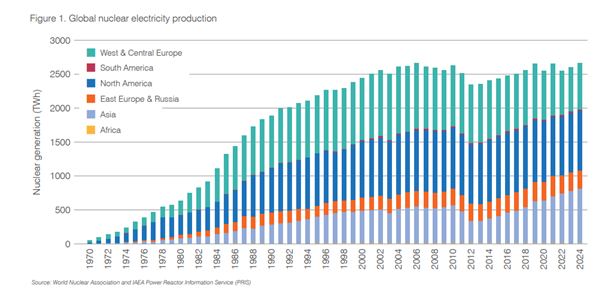
It is in Asia that the growth in nuclear generation was strongest, with five reactors connected to the grid in 2024. Production also increased in Western and Central Europe thanks to France, which experienced a return to service of its reactors after outages in 2022 and 2023. In other regions of the world, production remained broadly stable compared to 2023.
A total capacity of 369 GWe
In 2024, with seven grid connections and four permanent shutdowns, the number of operable reactors reached 440 units in service. Even though the historic record of 2019 (448 reactors) was not equaled, generation reached a new peak thanks to an installed capacity of 369 GWe, one gigawatt more than in 2023.
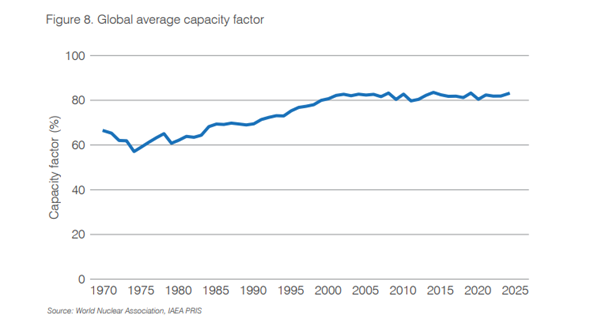
In 2024, the global average capacity factor stood at 83%, compared to 82% in 2023, continuing the trend of high worldwide capacity factors observed since the 2000s.
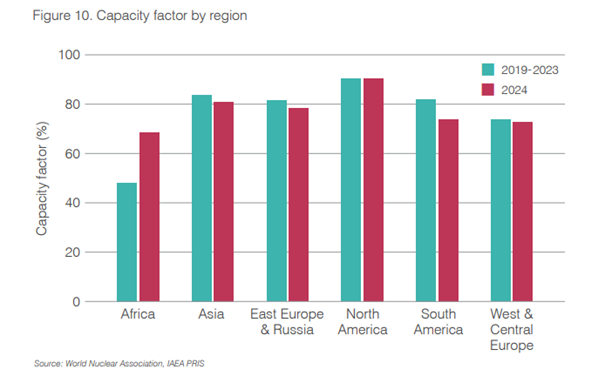
The highest average capacity factor was recorded in the United States, with an average rate of 90%. This first place is due to increased operational efficiency thanks to improved maintenance since the 1970s, according to the WNA report Nuclear Power in the USA.
Making it the norm
In this report, Director General Sama Bilbao y León emphasized:
“The new record of 2,667 TWh produced by nuclear energy in 2024 demonstrates the potential of nuclear power. However, to achieve our global energy and climate objectives, this is a record that must be broken again and again, every year, and by ever greater amounts.”
To this end, the Director General pointed to two actions. First, the need to maximize the contribution of the existing fleet, by achieving high performance standards and extending operations. Second, the importance of rapidly accelerating the pace of new construction.
Since COP29 in 2024, 31 countries have pledged to support the goal of tripling global nuclear capacity by 2050. Since 2021, nuclear generation has grown on average by 25 TWh per year. To achieve the tripling objective, an average increase of 200 TWh per year would be needed, equivalent to the addition of around 28 GWe of new capacity. Yet only 11 GWe per year are scheduled over the next five years. It is therefore essential to “usher in a new era of accelerated nuclear construction,” stressed the WNA Director General. ■