
Towards the End of the Franco-German Divide on Nuclear?
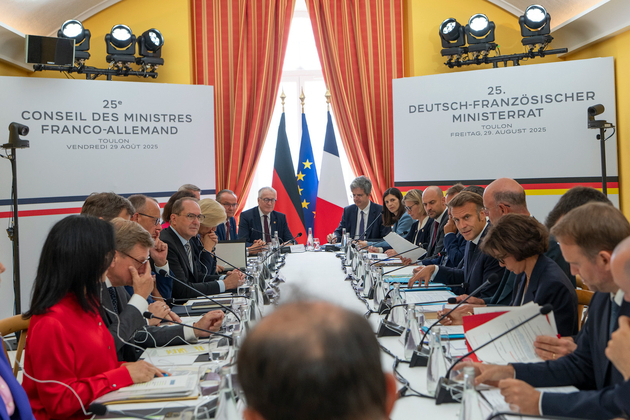 After two decades of deep disagreements over energy strategy and the role of nuclear power in Europe’s energy mix, France and Germany are beginning to align. While nothing has been formally decided yet, the principle of technological neutrality seems to satisfy both sides.
This may mark the end of one of Europe’s most significant energy policy battles. At the close of the 25th Franco-German Council of Ministers in late August, the French Ministry of Energy announced that the two countries would work together to promote the principle of technological neutrality in European regulation. “We need to move beyond this confrontational approach to energy strategy, and, ultimately, we must recognize the legitimacy of each other’s energy orientations,” stated Marc Ferracci, Minister for Industry and Energy, during a press conference.
In concrete terms, the two European powers aim to recognize their respective strategies and avoid blockages as long as the technologies involved are low-carbon. In short, this is another step toward ending the discrimination against nuclear power—a stance traditionally supported by Germany. This development could reshape how nuclear energy is treated within European low-carbon support policies, as well as within the European Investment Bank or the World Bank. Back in early May 2025, during a visit to Paris, German Chancellor Friedrich Merz had already signaled his intention to put an end to his country’s anti-nuclear stance—a decision that divided his coalition partners.
The Franco-German partnership has also been formalized through the signing of a memorandum of understanding between Bpifrance and SprinD, Germany’s innovation agency. Although the terms of this partnership are still being worked out, the French Ministry of Economy and Finance indicated that innovative nuclear technologies—including nuclear fusion—would be among the covered projects, alongside artificial intelligence.
RED directives under scrutiny
For the French government, alignment on technological neutrality also aims to modernize the European Renewable Energy Directive (currently RED III). “The key issue is that the next EU energy-climate package, scheduled for 2026–2027, should not include a fourth renewable energy directive—a RED IV—but instead a new piece of legislation, yet to be named, which must be technologically neutral,” explained the office of Marc Ferracci.
This position is also supported by the Institut Montaigne. In a note published at the end of 2024, the think tank recommended shifting from a target-based approach focused on the share of renewables in final energy consumption to one based on reducing carbon intensity. According to the Institut, the current approach—limited to the gradual deployment of renewables and energy efficiency—does not sufficiently account for “all the levers available to Member States.”
Currently, European legislative work on setting the EU’s 2040 climate target and the regulatory framework to achieve it is in full swing. While the Danish presidency of the Council of the EU has already circulated a draft compromise on the legislative proposal to set the EU’s net emissions reduction target at 90% by 2040, some are seeking alternatives. France, Poland, and German Chancellor Friedrich Merz, in particular, want the modalities to be discussed first by the leaders of the 27 Member States. Should this approach prevail, decision-making would be delayed at least until October 23–24, the date of the next European Council. ■