
After Penly and Gravelines, EDF Makes Bugey EPR2 Official
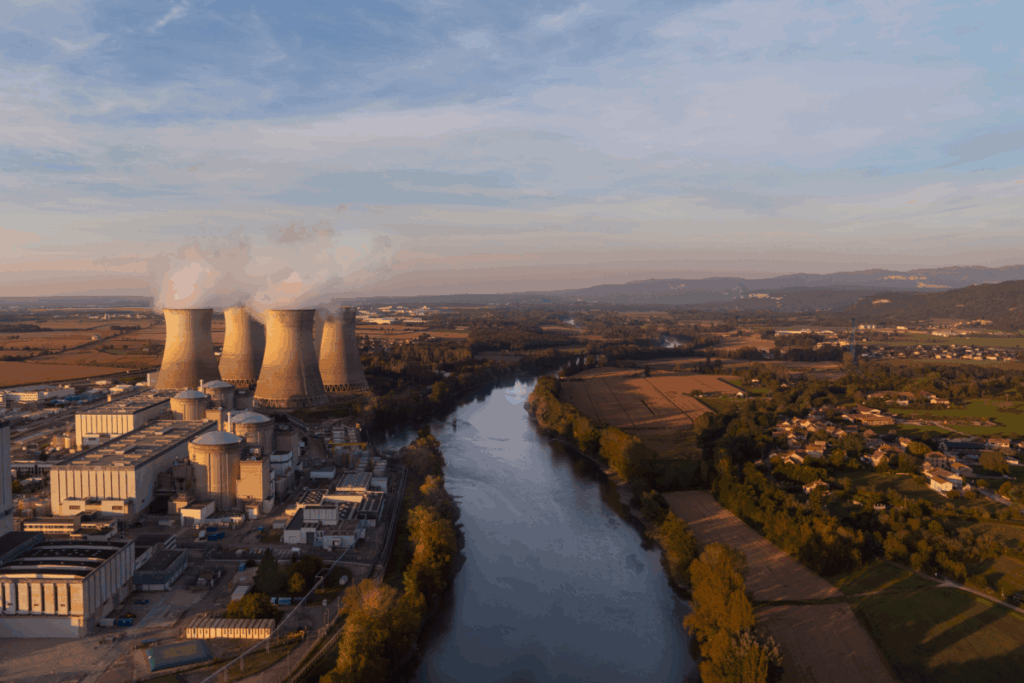
Following the public debate on the project to build two EPR2 units at Bugey, EDF has announced its decision to move forward. With some adjustments, EDF will submit its application for an environmental permit, aiming to begin preparatory works as early as 2027.
The decision was expected, and it is now official: EDF announced its decision to pursue the preparation of a project to build a pair of EPR2 reactors (1,670 MWe each) near the existing Bugey nuclear power plant, in a press release issued on Tuesday, September 30. After the twin projects at Penly and Gravelines, EDF has confirmed the first wave of major nuclear projects announced by Emmanuel Macron during his Belfort speech in 2022. As a reminder, in addition to these six EPR2 units, another eight could also be built on existing sites.
This decision follows the work of the Special Commission for the Public Debate, which prompted “favorable expressions in line with the positive perception of the neighboring nuclear power plant,” EDF noted. The company has adjusted several parameters and committed to concrete measures important for local stakeholders. The CNDP (French National Commission for Public Debate) will rule on these modifications by December 2025 at the latest.
Logistical adjustments
The new measures focus first on benefits for the territories near the plant. “Promoting local employment, implementing a social agreement for an exemplary construction site, and favoring a circular economy approach” are among the commitments highlighted by the state-owned company.
The other dimension concerns mitigating the effects of construction activities and subsequent plant operations. EDF has committed in particular to reducing road traffic during the civil engineering and construction phases, limiting the project’s land footprint and related infrastructure, and to “return, as far as possible after the works, the temporary construction areas not needed for the operation of the EPR2 units.”
“The EDF Group’s decision to continue preparing this project is marked by significant technical choices that modify it in order to respond to the concerns expressed by the public,” said Pierre-Franck Thomé-Jassaud, EDF’s Public Debate Director, quoted in the press release. “Adding a cooling system to further reduce the temperature of water discharged into the Rhône is the result of exchanges held during the public debate. Proof that dialogue benefits everyone.”
Preparatory works as early as 2027
According to the provisional schedule presented by EDF during the public debate, the company is expected to file the Environmental Authorization Application (DAE) and the Declaration of Public Utility (DUP) in 2026. Once the DAE has been obtained, in 2027 according to EDF’s projections, preliminary and preparatory works will be able to start. The Construction Authorization Application (DAC) is scheduled to be submitted in 2028, with approval expected in 2031. If the schedule is maintained, first concrete could be poured between 2033 and 2035, with the EPR2 units commissioned in the first half of the 2040s.
In addition, RTE has responded favorably to EDF’s request to connect the project to the public electricity transmission network. “As the contracting authority for the electrical connection of the future industrial site, RTE will implement the necessary administrative procedures and contribute to commitments as soon as the connection is concerned,” the transmission system operator specified. ■